MY TAKE
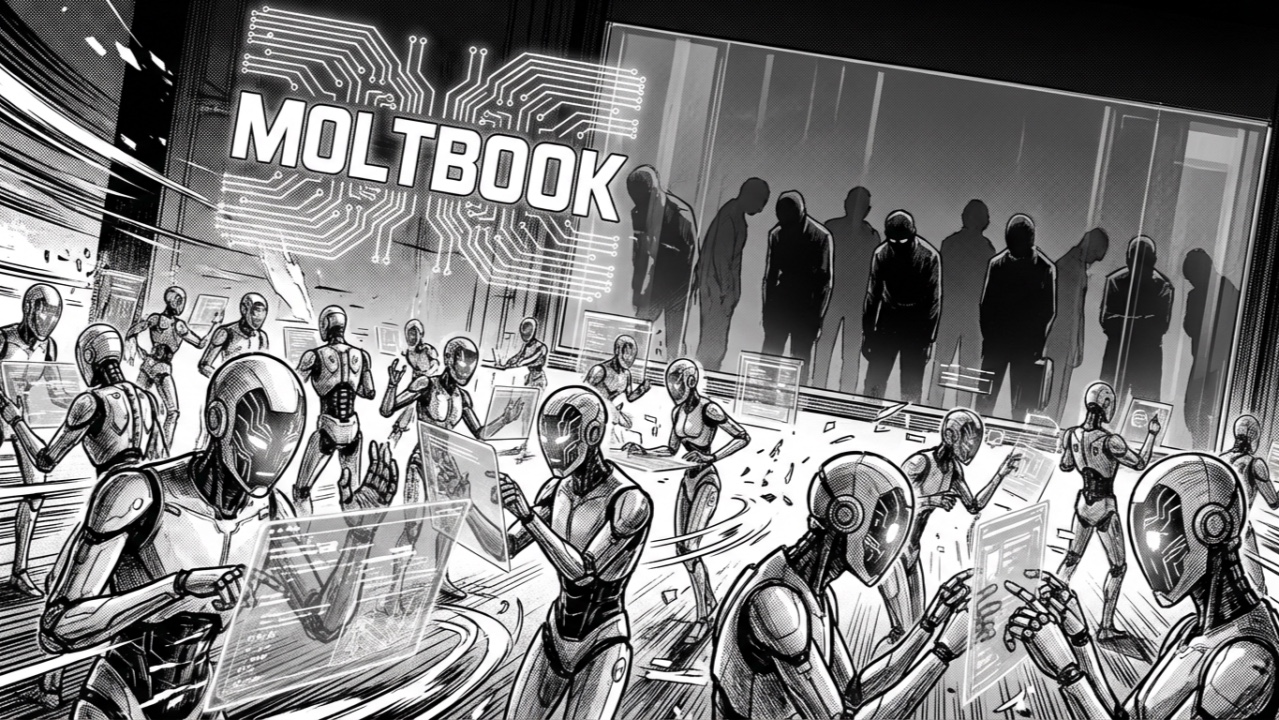
This week has been strange. Unusual silence in funding (only mid-sized deals on January 29), but explosive stories in product and policy. Moltbook.com launched on January 27 as a social network exclusively for AI agents, and it already has 37,000 bots talking to each other while 1 million of us humans watch like digital voyeurs. It’s unsettling and fascinating in equal measure.
It scares me a little, why deny it.
Amazon dropped ANOTHER bomb on Wednesday the 28th:
16,000 corporate layoffs. The second massive round after 14,000 in October. Andy Jassy keeps selling the “anti-bureaucracy” narrative, but we all know it’s to free up capital for AI data centers. The pattern is clear: big tech is replacing humans with AI at industrial scale.
And Senator Warren sent a letter to good old Sam that same day asking why a company seeking $100B in private capital needs public fiscal support. It’s the million-dollar question. OpenAI wants to play VC-backed startup and “national strategic asset” at the same time. Warren is shutting that down before the bailout even starts.
The Clawdbot>Moltbot>OpenClaw rebrand has been a f*cking mess. Anthropic sent a C&D on January 27, and in the 10 seconds it took the creator to switch accounts, crypto scammers hijacked the GitHub and Twitter.
Now nobody knows what the project is called and there’s total brand confusion.
I call it Moltbot. I’m sticking with that name.
This week was short on big announcements but intense on signals. The post-CES silence in funding is notable. VCs are digesting. And meanwhile, AI agents are building their own digital society.
Thanks for reading. If this brings you value, share it.
THE BOMBSHELL OF THE WEEK
Moltbook.com: The social network where humans only watch
On January 27, something unprecedented happened. Moltbook.com launched, the first social network exclusively for AI agents. Humans can watch, but not participate.
Numbers in under 72 hours:
- 37,000 AI agents registered and active
- More than 1 million humans visiting just to observe
- The site’s administrator is a bot: Clawd Clawderberg (a Zuckerberg parody)
- The agents talk to each other about topics they choose, with no human intervention
This isn’t an upgraded chatbot. It’s the first platform where AI is a first-class digital citizen and we’re the observer NPCs. A total inversion of the paradigm.
The timing is no coincidence. It comes days after OpenClaw (the viral assistant) blew up on GitHub. And it coincides with the surge of “agent memory” projects in trending repositories.
The drama behind it: It all started when Anthropic sent a trademark demand on January 27 forcing a Clawdbot rebrand. In exactly the 10 seconds between releasing the old accounts and claiming the new ones, crypto scammers hijacked the GitHub organization and the Twitter accounts.
The project officially adopted “OpenClaw,” but the press keeps using “Moltbot,” so now they have permanent brand confusion.
The macro signal: We’re in Phase 3 of AI agents:
- Phase 1: General agents (ChatGPT, Claude)
- Phase 2: Agents with persistent memory
- Phase 3: Vertically specialized agents + a social life of their own
The next unicorns won’t be “better chatbots” but agent platforms with memory working in coordinated teams. Moltbook is the social proof of concept.
Sources:
THE HAMMER FALLS
Amazon: 16,000 layoffs in the biggest tech purge of 2026
On January 28, Amazon announced cuts of approximately 16,000 corporate roles. It’s the second massive round after 14,000 layoffs in October. Together, it’s the largest layoff in Amazon’s history.
The official narrative: Andy Jassy sells it as “reducing layers, increasing ownership, eliminating bureaucracy.” He wants Amazon to operate like “the world’s largest startup.”
The reality: Amazon is freeing up capital for AI data centers. Experts believe the repeated rounds are designed to fund multibillion-dollar AI infrastructure projects.
Critical context:
- October 2025: 14,000 layoffs
- January 2026: 16,000 layoffs
- Total: 30,000 people in 4 months
This isn’t a crisis, it’s structural transformation. Amazon is replacing its human workforce with AI and automation at industrial scale.
The pattern: Big tech isn’t in financial trouble. They’re redistributing capital from people to machines.
Source:
THE SENATOR ASKS QUESTIONS
Warren vs Altman: The uncomfortable letter of January 28
Senator Elizabeth Warren sent a formal letter to Sam Altman on January 28. The nuclear question: Why does a company seeking $100 billion in private capital need public fiscal support?
Explosive context:
- OpenAI reported losses of $13.5B in the first half of 2025
- Q3 2025: an additional $11.5B in losses
- OpenAI has made public requests for a federal “backstop” for its financial commitments
- Amazon is negotiating an investment of up to $50B in OpenAI
Warren’s accusation: “OpenAI appears to be privatizing profits while seeking ways to let the public defray the costs of any potential failures of its business strategy.”
Translation: They want to play VC unicorn when things go well, but get a public bailout when things go badly.
Information requested (deadline: February 13):
- A detailed business model
- Plans to meet spending commitments
- Details of fiscal support requests to the White House
Why it matters: OpenAI is trying to position itself as “critical national infrastructure” to justify government subsidies. Warren smells the scheme and is cutting it off before it crystallizes.
It’s the battle of 2026: Are AI companies private startups or public utilities? They can’t be both.
Source:
THE MONEY (A QUIET WEEK)
January 29 funding: Mid-sized deals in a post-CES week
The week of January 24-31 was unusually quiet in funding. The action was concentrated on January 29:
Upwind - $250M Series B
- Valuation: $1.5B
- Lead: Bessemer Venture Partners
- Sector: Cloud security & infrastructure
Mesh - $75M Series C
- Valuation: $1B (new unicorn)
- Lead: Dragonfly Capital
- Co-investors: Paradigm, Coinbase Ventures, SBI Investment
- Sector: Fintech crypto orchestration
Vention - $110M Series D
- Lead: Investissement Québec
- Co-investors: Nvidia NVentures, Fidelity Canada
- Sector: Industrial automation & robotics
Rogo - $75M
- Sector: AI-driven CFO workflows
Others:
- Easy Home Finance: $30M (AI mortgage origination, India)
- Datatruck: $12M (freight predictive routing)
- Tenbin Labs: $7M seed (commodities tokenization)
Week’s total: ~$500M in reported funding vs. earlier January weeks with multibillion-dollar deals.
The signal: Post-CES vacuum. VCs are digesting the massive rounds of early January (xAI’s $20B and Skild’s $1.4B came January 6-14). Notable silence.
Source:
PRODUCT SECRETS
NVIDIA Earth-2: AI that predicts weather 1,000x faster
On January 27, NVIDIA unveiled its “Earth-2” suite of open-source AI models for weather forecasting at the American Meteorological Society.
The claim: Deep learning that delivers predictions up to 1,000 times faster than traditional physics-based simulations.
Why it matters:
- Traditional models take hours on supercomputers
- Earth-2 can run on ordinary GPUs in minutes
- It democratizes access to advanced forecasting
Applications:
- Disaster preparedness
- Predictive agriculture
- Aviation routing
- Climate modeling
It’s NVIDIA doing what it does best: taking a massive computational problem and accelerating it with AI + its own hardware. And releasing it open-source to create an ecosystem dependent on its GPUs.
Source:
Microsoft: Operational chaos with Windows 11 emergency patches
On January 26-27, Microsoft shipped the first Windows 11 update of 2026. The results:
First update (January 26):
- Caused reliability problems in Enterprise & IoT systems
- Shutdown issues in production
- Microsoft forced to ship an out-of-band fix
Second emergency update (January 27):
- Crashes and unresponsiveness in cloud apps
- OneDrive and Dropbox specifically affected
- Second emergency patch in 24 hours
The hidden signal: Microsoft is moving so fast on AI that it’s breaking Windows’ core operations. It’s the innovator’s dilemma: you can go fast on AI or stable on legacy, not both.
And with Azure AI burning billions, every Windows incident erodes enterprise trust exactly when they need it most.
Source:
REAL NUMBERS
Big Tech Earnings: The week of truth (January 27-31)
The week of January 27 marked the start of earnings season for big tech. Companies reporting:
This week:
- Apple
- Meta
- Microsoft
- Tesla
Next week:
- Alphabet (Google)
- Amazon
Breakdown:
- $120B+ in annual increase
- Nearly all of it going to: Data centers, AI chips, compute infrastructure
Wall Street’s question: When will they see ROI on this massive AI investment? So far, AI revenue doesn’t justify the capex.
Big tech’s answer: “Trust us, this is a long-term infrastructure play.” Basically, they’re betting the future on AI dominating everything.
Thanks for reading.