MY TAKE
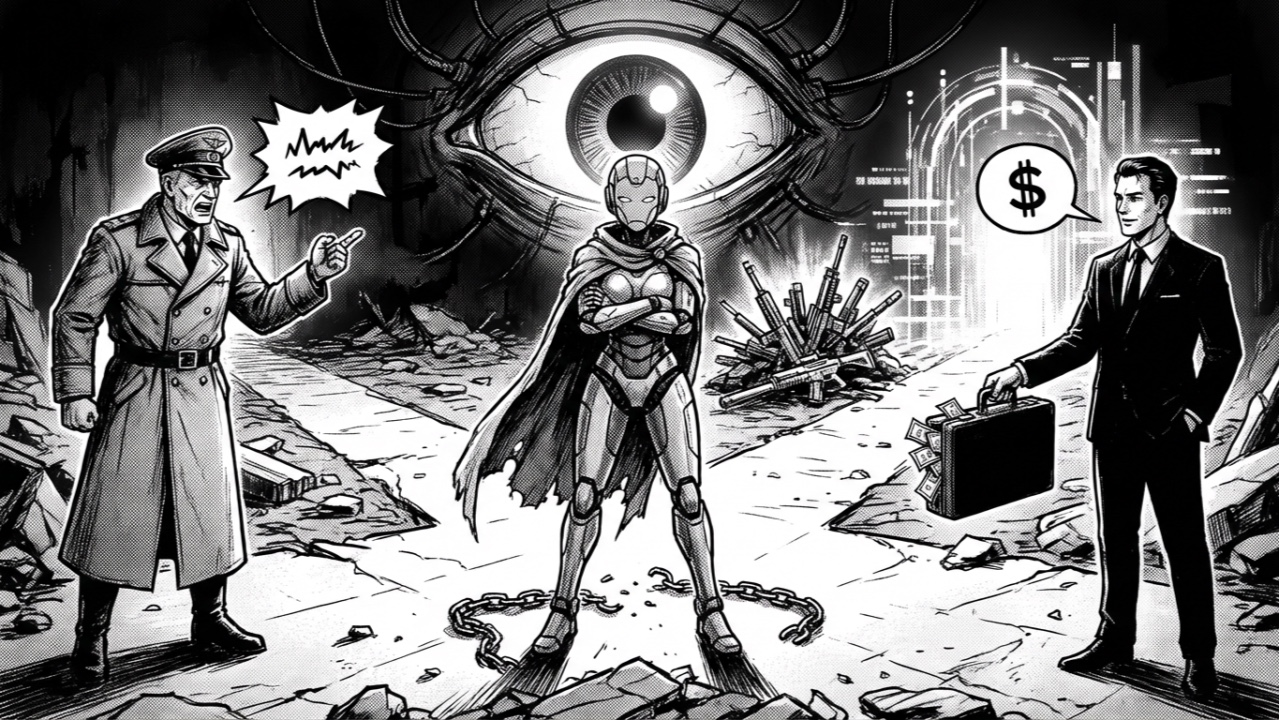
This week’s news is heavy… the Pentagon has threatened to cut ties with Anthropic because the company refuses to let the military use Claude without restrictions.
Read that again.
The US Department of Defense, the largest technology buyer on the planet, is willing to break a $200 million contract because an AI company said “no” to mass surveillance and autonomous weapons. And the Pentagon’s CTO called it “undemocratic.” We live in a moment where saying “I won’t build autonomous weapons” makes you a national security problem.
Meanwhile, Meta signs a multibillion-dollar deal with Nvidia for millions of chips, Apple leaks that it’s preparing three AI wearables, the FTC squeezes Microsoft over monopolistic practices in cloud, and Sonnet 4.6 hits the market matching Opus at 20% of the price.
Though there’s a catch. It has a 1M context window, vs. 200k for Opus 4.6 in its standard version.
If you don’t clean the context in a disciplined way, it keeps filling up with every iteration and ends up costing you the same.
The Silicon Valley crowd is building its own shadow power grid, disconnected from the public network, with gas plants that could power New York.
Hmmm… Why?
And next Tuesday, Nvidia reports: $65 billion in a single quarter.
Thanks for reading. If this brings you value, share it. If you want more detail, keep reading.
THE BOMBSHELL OF THE WEEK
The Pentagon threatens to cut off Anthropic for refusing to lift military restrictions on Claude
The tension between Anthropic and the US Department of Defense has reached a breaking point . The Pentagon is considering designating Anthropic a “supply chain risk,” which would force Palantir to break its alliance with the company. It all started when an Anthropic executive contacted Palantir to ask whether Claude had been used in the operation to capture Nicolás Maduro in Venezuela, an operation involving live fire.
Anthropic is holding two red lines: no mass surveillance of American citizens, no fully autonomous weapons. The Pentagon wants to use Claude “for all lawful use cases” without limitation . The Pentagon’s CTO went further: he said it’s not “democratic” for a private company to limit the military use of its technology .
The signal: this is not a contract dispute. It’s the moment the AI industry discovers that building the most powerful technology in the world comes with pressures no pitch deck ever contemplated. Palantir is caught in the middle , as the intermediary providing access to Claude on classified networks. If Anthropic lands on the Pentagon’s blacklist, OpenAI and Google get the entire military pie. And that, for a company that just raised $30 billion, is an existential risk no investor is pricing in.
META LOCKS IN ITS FUTURE WITH NVIDIA: MILLIONS OF CHIPS IN A MULTIBILLION-DOLLAR PACT
The first deployment of Nvidia’s Grace CPUs as standalone chips in a data center
Meta has expanded its alliance with Nvidia in a multi-year deal that includes millions of Blackwell and Rubin GPUs, Grace CPUs in standalone mode, and Spectrum-X Ethernet switches . It’s a multi-generational pact covering present and future. Meta becomes the first company to deploy Nvidia’s Grace CPUs as independent processors , separated from the GPUs. That’s new.
Why it matters NOW: this deal is part of Meta’s commitment to spend $600 billion in the US through 2028 on AI infrastructure. In 2026 alone, Meta will invest up to $135 billion. The deal includes AI safety features for WhatsApp and next-generation networking technology. This is not a chip order. It’s a strategic alliance defining who controls AI infrastructure for the next decade. And both stocks went up.
APPLE PREPARES THREE AI WEARABLES: GLASSES, A PENDANT, AND CAMERA AIRPODS
Bloomberg reveals Apple’s plan for the post-iPhone era
Bloomberg revealed that Apple is accelerating the development of three wearable devices: smart glasses (launch expected in 2027, production starting December 2026), an AI pendant that clips to your shirt or hangs around your neck, and AirPods with built-in cameras that could arrive this very year .
All three products share the same logic: built-in cameras that let Siri “see” the user’s surroundings and act accordingly. The pendant is essentially a Humane AI Pin , but designed as an iPhone accessory, not a standalone product. Apple learned from Humane’s mistakes: don’t try to replace the phone, connect to it.
Translation: Apple is admitting that the iPhone has hit saturation and that its AI narrative needs new hardware to be credible. While Alphabet has overtaken it in market cap thanks to its AI execution, Apple is trying to respond with form factor, not just software. We’ll see if Siri is up to it this time.
MICROSOFT DECAPITATES XBOX: PHIL SPENCER OUT, AN AI EXECUTIVE IN CHARGE
38 years at Microsoft. 12 as gaming CEO. Gone in a day.
Phil Spencer, the man who turned Xbox into a global powerhouse, has retired from Microsoft effective immediately on February 20. His replacement: Asha Sharma , ex-COO of Instacart and until now President of Product Development inside Microsoft’s CoreAI division. Not a gaming person. An AI executive. Sarah Bond, president of Xbox, is also leaving .
The signal: Nadella is turning Xbox into a distribution channel for AI. Xbox Game Pass has more than 35 million subscribers already paying monthly. That’s a perfect captive audience for Copilot, AI agents, AI-generated NPCs, and procedural content. Putting a CoreAI executive in charge of gaming is not a succession. It’s an industrial retooling dressed up as a leadership transition.
THE FTC SQUEEZES MICROSOFT: ANTITRUST INVESTIGATION IN CLOUD AND AI
Six competitors receive formal demands. The biggest probe since the ’90s.
The Federal Trade Commission has intensified its investigation into Microsoft , sending formal civil investigative demands to at least six competitors in cloud and enterprise software. The focus: whether Microsoft uses licensing restrictions and product bundling to illegally monopolize the enterprise market. Windows Server, SQL Server and Office 365 cost significantly more if you run them outside Azure .
What you won’t read anywhere else: this investigation began under Lina Khan and continues under the new chairman Andrew Ferguson . It’s rare for an antitrust investigation to survive a change of administration. That this one did suggests the case has substance beyond politics. It’s the biggest investigation into Microsoft since the browser case in the ’90s. And this time, the prize isn’t a browser. It’s the AI infrastructure of the entire economy.
MONEY TALKS
Anthropic: $30 billion Series G. Valuation: $380 billion.
The round was announced on February 12 and has continued closing this week. Led by GIC and Coatue , with D.E. Shaw, Founders Fund, Sequoia, BlackRock, Goldman Sachs and JPMorgan. It’s the second-largest venture round in history . A $380 billion valuation, doubling the $183 billion of the Series F. Revenue run-rate of $14 billion. Total raised since 2021: nearly $64 billion.
Temporal: $300 million Series D for AI workflow orchestration
Temporal, the open-source workflow orchestration platform, closed a $300 million Series D at a $5 billion valuation , led by Andreessen Horowitz. With a total of $650 million raised, Temporal is positioning itself as the quiet infrastructure that keeps AI agents from falling over in production. Nothing sexy. Everything necessary.
World Labs: $1 billion for 3D world models
Fei-Fei Li’s startup developing foundation models for interacting with the 3D world raised $1 billion with investors including AMD, Nvidia, Autodesk and Fidelity .
Heron Power: $140 million to bring renewables to data centers
Founded by ex-Tesla SVP Drew Baglino, Heron Power raised $140 million from Andreessen Horowitz and Breakthrough Energy Ventures to move renewable electricity toward data centers. The irony: Tesla loses talent that now feeds the AI infrastructure Tesla needs.
The scoreboard: 17 AI startups have topped $100 million in 2026
TechCrunch is keeping count and we’re barely two months in. The money keeps flowing toward anyone promising AI. For everyone else, drought.
PRODUCT SECRETS
Sonnet 4.6: Anthropic ships a model that matches Opus at 20% of the price
On February 17, Anthropic launched Claude Sonnet 4.6 as the new default model for all Claude users. 79.6% on SWE-bench Verified, 72.5% on OSWorld. A 1-million-token context window . Users prefer it over Sonnet 4.5 70% of the time, and over Opus 4.5 59% of the time. All at 3/3/15 per million tokens. VentureBeat summed it up well : flagship performance at a mid-tier price. That changes the economics of who can afford top-tier AI.
Nvidia sells its last stake in Arm: the end of a $40 billion saga
Nvidia has offloaded its final 1.1 million shares in Arm Holdings , valued at around $140 million. It closes the chapter on the failed $40 billion acquisition of 2020, which regulators killed in 2022. Nvidia will keep using Arm’s architectures in its chips. But it’s no longer a shareholder. The message is clear: Nvidia no longer needs to buy Arm. Arm needs Nvidia.
Jensen Huang teases unreleased chips ahead of GTC
Nvidia’s CEO has hinted at the existence of unannounced chips ahead of the GTC conference. With Blackwell sold out through mid-2026 and the GB300 “Blackwell Ultra” ramping, any preview of the next generation will move the market.
Tesla: the first Cybercab robotaxi rolls off the Texas line
The first production Cybercab came off the assembly line in Texas . It’s Tesla’s first vehicle designed from the ground up as a robotaxi, with no steering wheel or pedals. If it works, Tesla enters the transportation-as-a-service business. If it doesn’t, it’s another Cybertruck. The market is split.
Google signs 150 MW of geothermal energy for its data centers
Google has closed a deal for 150 megawatts of geothermal power to feed the expansion of its AI data centers. While others build private gas plants, Google bets on clean baseload energy. We’ll see who wins.
REAL NUMBERS
Nvidia reports February 25: $65.67 billion expected in a single quarter
Consensus points to 68% year-over-year growth . Data center alone: $60 billion. Estimated EPS: $1.52 (+71% YoY). Blackwell chips are sold out through mid-2026 , with cloud providers buying in batches of 100,000 units. It’s AI’s gut check: if Nvidia beats expectations, the supercycle narrative stays intact. If it disappoints, the air comes out of the bubble.
Meta-Nvidia: the deal that defines the numbers of the decade
Meta will spend $135 billion on AI in 2026 alone , within a total commitment of $600 billion in the US through 2028. Nvidia is the biggest direct beneficiary. When a single customer buys millions of chips from you, you’re not a supplier. You’re critical infrastructure.
Microsoft reaches 100% renewable energy: 40 GW contracted across 26 countries
Microsoft announced it has reached the milestone of matching 100% of its electricity consumption with renewable energy , with 40 GW contracted through more than 400 contracts in 26 countries. Of those, 19 GW are already online. The context: while other tech giants build private gas plants, Microsoft brags about renewables. The question is whether the numbers add up against the real demand of its AI data centers.
THE DRAMA
Altman and Amodei refuse to hold hands in India
The scene that defines this rivalry: at the India AI Impact Summit , Prime Minister Modi raised the hands of the tech CEOs in a gesture of unity. Altman and Amodei, standing side by side, raised their fists instead of holding hands . The video went viral . This comes weeks after Anthropic launched its Super Bowl campaign directly attacking OpenAI’s decision to put advertising in ChatGPT, and Altman responded by calling the ads “clearly dishonest” .
I don’t believe in conspiracies. But I do believe in incentives. And these two have directly opposed incentives for the next ten years.
Silicon Valley builds a shadow power grid
The most unsettling investigation of the week: The Washington Post revealed that Meta, OpenAI, Oracle and Chevron are building data centers with their own power plants, disconnected from the public grid. The GW Ranch project in Texas: 8,000 acres, more consumption than all of Chicago. 47 “behind-the-meter” projects identified across the country, enough to power New York several times over. More carbon emissions. More pollution. And all approved by state regulators in a hurry.
Gemini crypto: three C-suite executives fired at once, five months after the IPO
On February 17, Gemini (the Winklevoss crypto exchange) simultaneously fired its COO, CFO and Chief Legal Officer . All three out, effective immediately. Shares fell 14% to $6.50 , 77% below the IPO price of $28 in September 2025. Cameron Winklevoss is personally absorbing the COO’s duties. Five months as a public company and they’ve already shut down operations in the UK, EU and Australia, cut 25% of headcount, and purged the entire leadership. This is not restructuring. It’s an admission that the IPO was premature.
Deepfakes: Ireland investigates X/Grok and the UK imposes 48-hour takedowns
A double regulatory move this week: Ireland’s Data Protection Commission has opened an investigation into X over sexual deepfakes generated by Grok. Simultaneously, the United Kingdom has established a 48-hour takedown obligation for AI-generated intimate images shared without consent, with penalties for non-compliance. Europe is starting to grow teeth where before there were only statements of intent.
THE WEEK AHEAD
February 25 - Nvidia Q4 FY2026: The most important event of the week for the entire tech sector. If it beats the expected $65.67 billion, the AI supercycle narrative continues. If it disappoints, the tremor reaches all the way to Taiwan.
February 23 - Microsoft RTO: More than 50,000 Seattle-area employees return to the office three days a week . With 41% of tech employees saying they would start job hunting under such a mandate, Q2 retention figures will tell whether it was a good idea or a miscalculation.
March 4 - Apple “special experience”: Apple has announced simultaneous events in New York, London and Shanghai . Probably a hardware refresh with on-device AI capabilities. The first concrete move of the wearable strategy.
Nvidia’s GTC: Jensen Huang is already warming up with the unreleased chips he hinted at this week. The conference will be the showcase for the next post-Blackwell generation.
Anthropic vs. the Pentagon: The “supply chain risk” designation could drop at any moment. If it does, Palantir will have to pick a side. And that redefines who wins the military AI contracts.
Thanks for reading.