MY TAKE
Last week I opened the newsletter writing that Anthropic had won the AI war — now I’ll add, “without firing a shot.” This week it fired three shots, and all three hit the target.
Shot one, Tuesday, May 19. Andrej Karpathy posts on X: “Personal update: I’ve joined Anthropic.” Karpathy is not just another hire.
He’s the person I admire most in this nascent world of AI.
He’s a co-founder of OpenAI (2015), former head of AI at Tesla, author of the most-watched deep learning course in history, and one of the few technical communicators we all respect.
He joins the pre-training team under Nick Joseph, in a group dedicated to using Claude to accelerate Claude’s own training — that is, recursion.
This surprised me. The edge in LLMs usually isn’t in pre-training but in what comes after, so something is cooking, trust me.
Karpathy doesn’t need money or visibility. He’s leaving for something more concrete: because technically, he believes the frontier is at Anthropic.
Shot two, Friday, May 22. Bloomberg confirms that Anthropic’s $30 billion round, at a valuation above $900 billion, closes “this week or next.” Sequoia, Dragoneer, Altimeter, and Greenoaks co-lead with roughly $2 billion each.
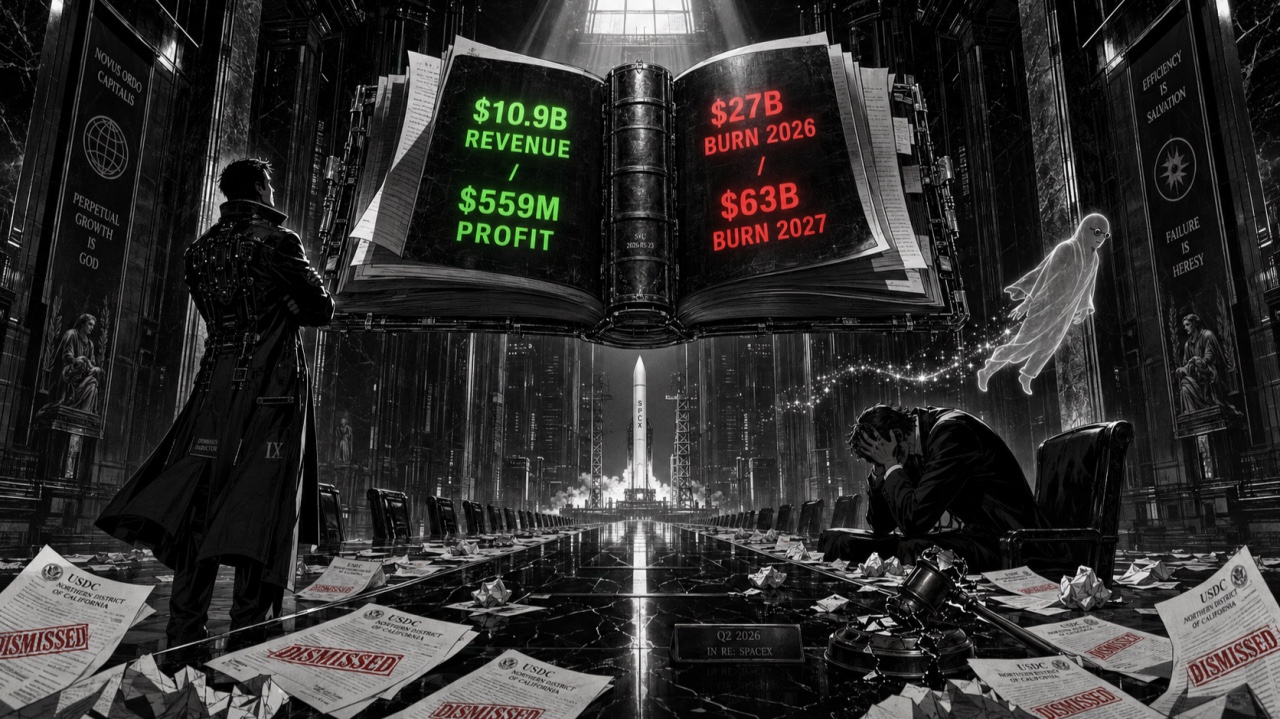
Shot three, Thursday, May 21. CNBC publishes the internal figures Anthropic has sent to investors: Q2 2026 will close at $10.9 billion in revenue — more than double the $4.8 billion of Q1 — and with an operating profit of $559 million.
It’s the company’s first profitable quarter.
Could this have something to do with it? Possibly yes.
OpenAI will burn roughly $27 billion in 2026, $63 billion in 2027, and a cumulative $218 billion between 2026 and 2029, according to its own internal investor documents.
SpaceX, which this very week disclosed its preparatory S-1 for the IPO, revealed an operating loss of $6.4 billion in its AI operation alone. Anthropic forecasts cash burn at 33% of revenue in 2026, dropping to 9% in 2027. OpenAI expects to keep its burn at 57% of revenue in both years.
It seems to me the market is starting to discriminate between labs with a clearer technical thesis and sustainable economics (Anthropic) and labs that need to finance growing losses with ever-larger rounds (OpenAI, xAI).
There’s a satellite data point that will be remembered. The Oakland jury took less than two hours to decide, unanimously, that all of Musk’s claims against Altman were outside the statute of limitations. Two hours. It wasn’t a debate. And Musk reacted on X calling it a “calendar technicality” and promising to appeal. The public narrative is that Altman has won in court.
The real narrative is that not even the judicial bottleneck can save OpenAI from the structural problem: the transfer of talent, capital, and operational efficiency toward Anthropic is happening in parallel, and Friday’s ruling doesn’t stop it — it just frees it from a distraction.
My prediction for the next 90 days. Anthropic announces its IPO before September. Karpathy publishes a technical post before summer explaining, without naming names, why his decision was technical and not narrative — and that post moves more talent than the departure itself. OpenAI raises another round, this time below the $1.5 trillion that was being speculated three months ago, and the gap between the two valuations closes: for the first time in years, Anthropic could be worth more than OpenAI in absolute terms.
The oligopoly carve-up that a week ago I said was down to “the final tables” has closed the betting this week. What comes next is the reveal.
I’ll leave you with my minions.
THE BOMBSHELL OF THE WEEK
Anthropic executes the perfect week: signs Karpathy, closes a round at $900B, and projects its first operating profit
Three announcements in five days that, read separately, are each front-page news. Read together, they are the symbolic close of the regime change this newsletter has been documenting for two months.
Timeline of the week:
Tuesday, May 19, 10:47 Pacific time. Andrej Karpathy posts on X: “Personal update: I’ve joined Anthropic. I think the next few years at the frontier of LLMs will be especially formative. I am very excited to join the team here and get back to R&D. I remain deeply passionate about education and plan to resume my work on it in time.” Coverage is immediate: TechCrunch, Axios, CNBC, and VentureBeat publish pieces within the hour. Karpathy joins the pre-training team under Nick Joseph, and specifically a new initiative focused on using Claude to accelerate the pre-training process itself — in practice, recursive optimization of the lab’s most expensive compute. (TechCrunch , Axios )
Track record: Karpathy was a founding member of OpenAI in 2015, led AI at Tesla, returned to OpenAI in 2023, and left just a year later to found Eureka Labs, his education project. That a historic OpenAI co-founder returns to a frontier lab — and chooses the direct rival of his original co-founding — is the most expensive talent signal Anthropic has paid for to date. The package hasn’t been disclosed, but given the comparable with the hires Meta has closed with Thinking Machines co-founders (tens of millions into three digits in some cases), it’s reasonable to assume the compensation exceeds $100 million in equity with accelerated vesting.
Thursday, May 21. CNBC publishes Anthropic’s Q2 2026 figures sent to investors: $10.9 billion in revenue (more than double Q1) and $559 million in operating profit. It’s the first quarter with a positive result in the company’s history. Anthropic forecasts closing 2026 with cash burn at 33% of revenue, dropping to 9% in 2027. (CNBC , Dataconomy )
Friday, May 22. Bloomberg confirms Anthropic’s round is closing “as soon as next week” and exceeds $30 billion in primary capital, at a valuation above $900 billion. Sequoia Capital, Dragoneer Investment Group, Altimeter Capital, and Greenoaks Capital Partners co-lead with roughly $2 billion in investment each. (Bloomberg , TechTimes )
Comparative financial context. Over the same period, OpenAI has told investors that its projected cash burn has moved up from a cumulative $218 billion (2026–2029) to a higher figure — which some sources place at $27 billion for 2026 alone and $63 billion for 2027. SpaceX, in its IPO preparation, has disclosed an operating loss of $6.4 billion in its AI business line alone (mainly xAI). xAI, per the same sources, doesn’t expect to be profitable until after 2030.
The triple combination — talent, valuation, profitability — happening in the same week is what turns these three announcements into a single story. Anthropic has shown it can attract its rival’s historic talent (Karpathy), that the private capital market grants it a valuation premium above OpenAI ($900B vs ~$600B in the secondary), and that the business’s unit economics work (first operating profit). It’s the trinity that justifies going public.
The signal: the temporal compression — five days for three announcements any lab would have spaced across a quarter — is deliberate. Anthropic is setting the calendar for a fall 2026 IPO. The primary round at $900B is, in reality, a roadshow warm-up round: it brings in Sequoia, Altimeter, and Dragoneer as late investors who will later serve as anchors in the public listing. The Karpathy hire is the technical brand icon you need for a credible S-1. The Q2 figures are the documentary proof that the economics work. What we’re watching is the best-executed pre-IPO choreography Silicon Valley has seen since Snowflake’s 2020 debut.
POWER MOVES
Andrej Karpathy: OpenAI → Anthropic, pre-training team
Already covered in The Bombshell, but it deserves a spot here too because it is, symbolically, the executive move of the week. Karpathy brings three things Anthropic didn’t have: (1) top-authority technical credibility for recruiting the next layer of researchers — his mere presence justifies rivals rewriting their offers, (2) unique compute-optimization experience from Tesla, where he ran Autopilot under extreme hardware constraints, and (3) a public personal brand. Karpathy has 1.5 million followers on X and his technical content is required reading for any ML team in the world. For Anthropic, traditionally an inward-facing lab, this changes its ability to project external narrative. (CNBC )
Parag Agrawal returns to the ring: Parallel closes $100M at a $2B valuation
Parag Agrawal, Twitter’s last CEO before the Musk acquisition, closed this week a $100 million Series B for Parallel, his AI search infrastructure startup, led by Sequoia Capital at a $2 billion post-money valuation. The read: Sequoia is paying a multiple of roughly 20x revenue for a direct competitor in search infrastructure for agents, a segment where Exa Labs also competes (which this same week closed $250M at $2.2B led by Andreessen Horowitz). That two nearly simultaneous venture rounds in the same subsegment both hit unicorn valuations above $2 billion is a signal the market has decided the “search APIs for LLM agents” sub-segment is a duopoly with room for two. Agrawal’s personal timing — founding and scaling in under two years after the Twitter firing — is the fastest reputational rehabilitation Silicon Valley has seen in decades. (TechCrunch — AI search startups are blowing up )
Decart scales to $4 billion with Nvidia at the table
Decart closed this week $300 million led by Radical Ventures, with direct participation from Nvidia, at a valuation near $4 billion. The product — Decart Optimization Stack — lets developers move AI workloads between chips from Nvidia, Amazon, Google, and other providers transparently. The interesting signal: Nvidia, which has historically avoided investing in startups that ease portability across architectures (lock-in is its moat), enters here as an investor. The most likely read is defensive: it prefers participating in the upside of an inevitable abstraction layer to being left out. It’s the first public signal that even Nvidia assumes the market is going multi-chip faster than expected. (Crescendo — Latest AI Startup Funding News )
MONEY TALKS
Anthropic, $30 billion at a $900 billion valuation: the covert roadshow
Covered in The Bombshell but deserving specific financial analysis. The structure of the round reveals the strategy. Sequoia, Dragoneer, Altimeter, and Greenoaks each investing roughly $2 billion — four investors with $8 billion aggregate of the $30 billion total — is an unusual concentration. Standard practice in growth rounds with tickets above $10 billion is to spread across 8–15 investors to diversify risk. Four funds absorbing a third of the total means Anthropic has prioritized quality over coverage: these are four funds that historically buy substantial pre-IPO positions and hold through the first 24 months of public trading, serving as a price anchor. The signal is about calendar, not capital: Anthropic was very close to having cash for 36 months; what it needed was a cap table presentable to Wall Street. (Bloomberg )
The hidden data point in SpaceX’s S-1: $1.25 billion a month to Anthropic
SpaceX filed its S-1 prospectus with the SEC on Wednesday, May 20, clearing the path to its IPO under ticker SPCX on June 12 on Nasdaq. The headline number — $1.75 trillion valuation, up to $75 billion offered — was already priced in by the private market. What’s genuinely new, buried in the operational pages of the filing, is this: SpaceX pays Anthropic $1.25 billion per month for compute. Annualized, that’s $15 billion — roughly 25% of Anthropic’s projected 2026 revenue coming from a single customer. (Tech Startups — Top Tech News May 20 2026 )
Three readings. First, contractual: SpaceX — whose CEO is litigating against OpenAI and owns xAI — has decided its AI compute backbone is provided by Anthropic, not its own subsidiary. The technical signal about the relative maturity of the two models is brutal and public. Second, financial: Anthropic’s revenue concentration is high — if SpaceX renegotiated the contract downward for post-IPO margins, the impact on Anthropic’s projected Q2 ($10.9 billion) would be material. It’s the main customer risk Anthropic’s roadshow will have to address. Third, competitive: Microsoft has a similar contract with OpenAI at roughly $13 billion a year. Google pays roughly $8 billion to OpenAI via partners. The cross-dependencies between Big Tech and frontier labs are no longer rumor: they’re in SEC filings and audited financial statements.
The S-1 also confirms SpaceX closed 2025 with $18.7 billion in revenue (+33% YoY), led by Starlink ($1.2 billion in quarterly profit, more than 9 million users). The xAI line records an operating loss of $6.4 billion. The option to acquire Cursor for $60 billion — exercisable 30 days post-IPO, with a $10 billion break-up fee — has been confirmed as a clause in the prospectus. The IPO is simultaneously the largest in history and an implicit referendum on the Cursor deal. (TradingKey )
Exa Labs: $250M at $2.2B for agentic search infrastructure
Exa Labs closed this week a $250 million Series C led by Andreessen Horowitz at a $2.2 billion post-money valuation. The product: search APIs designed specifically to be consumed by LLM agents — not by humans in browsers. The a16z thesis: agents will generate between 100x and 1,000x more search queries than humans over the next 24 months, and current engines (Google, Bing, Brave) are architected for human latency, not agentic latency. The segment has bifurcated into two main competitors: Exa (Andreessen) and Parag Agrawal’s Parallel (Sequoia), both around $2 billion. The fight for the retrieval layer for agents already has presumptive winners — and both have $100–250 million tickets to spend on GTM over the next year. (TechCrunch — AI search startups are blowing up )
PRODUCT SECRETS
Google I/O 2026: Gemini 3.5 Flash, Omni, and the agentic bet
Google held I/O 2026 on Tuesday, May 19, with three material announcements and many satellites. The three that matter:
Gemini 3.5 Flash. The fast, cheap tier of the 3.5 family beats the previous Gemini 3.1 Pro on coding and agentic-task benchmarks. It runs 4× faster than comparable frontier models and at substantially lower cost. Immediate global launch through the Gemini app and AI Mode in Search. Gemini 3.5 Pro, in internal testing, will arrive in June. The read: Google has decided the short-term battle is against GPT-5 Mini and Claude Haiku 4 in the “fast & cheap” segment, not against the premium models. It’s a defensive margin play. (Business Standard )
Gemini Omni. A multimodal model for cinematic video generation from text, images, and clips. It competes directly with Sora 2 (OpenAI), Veo 3 (earlier Google DeepMind), and Runway Gen-5. Aggressive distribution: global launch for Plus, Pro, and Ultra subscribers from announcement day, and free availability for YouTube Shorts and YouTube Create app users starting this week. The read: Google is using YouTube’s installed base (2.5 billion users) to force Omni adoption before Sora 2 reaches scale. It’s the only distribution advantage Google has over OpenAI and they’re exploiting it. (Cybernews )
Gemini Spark + Antigravity. Spark is Google’s proactive agent: it runs workflows in the background, keeps state, and triggers actions without an explicit prompt. Antigravity is the agentic platform for developers (the conceptual equivalent of OpenAI’s Operator + Anthropic’s Computer Use). The strategic piece: Google is betting that the next generation of productivity will be agentic rather than conversational, and it’s packaging that bet in a consumer surface (Spark) and developer infrastructure (Antigravity). Google’s historical weakness in developer tooling distribution — Vertex AI has never been loved — makes Antigravity’s execution the real indicator to watch.
Anthropic + Karpathy: the recursive pre-training team
The new initiative Karpathy is joining — using Claude to accelerate Claude’s pre-training — is the least discussed product secret of the week and possibly the most important. The technical hypothesis: if Claude 4 can generate high-quality synthetic data for Claude 5’s training (instead of indiscriminate web scraping), and if Claude 4 can additionally optimize the training’s own architecture and hyperparameters, then the marginal cost of the next model drops substantially. This is exactly the “self-improving systems” thesis that has historically been the field’s holy grail. That Karpathy specifically chose this team — and not, say, post-training or evals — suggests Anthropic has preliminary internal results that justify betting at least one quarter of full-time work from its most expensive hire. The indicator to watch: any Anthropic technical publication on “compute-optimal pre-training data generation” over the next 90 days. (TechCrunch )
REAL NUMBERS
Anthropic Q2 2026: $10.9 billion in revenue (vs $4.8 billion in Q1) → +127% quarter over quarter. Projected operating profit: $559 million. It’s the company’s first profitable quarter. (CNBC )
OpenAI Q1 2026 (disclosed May 22): roughly $5.7 billion in quarterly revenue, driven by enterprise adoption, ad testing in ChatGPT, and the Codex coding agent. Still growing in absolute terms, but the relative data point is what matters: Anthropic already books more in Q2 ($10.9B) than OpenAI in Q1 ($5.7B). It’s the first time in history that Anthropic beats OpenAI in quarterly revenue. (Tech Startups — May 22 2026 )
Implication: at this pace, Anthropic would close 2026 with a run rate above $45 billion and a sustained positive operating margin. For context: Salesforce took 16 years to reach $13 billion in annual revenue.
OpenAI burn rate 2026–2029: $218 billion in cumulative losses per earlier internal documents. Revised projections raise the figure to roughly $27 billion in 2026 alone and $63 billion in 2027. Burn rate at 57% of revenue in both years. (Fortune , Sherwood News )
Implication: OpenAI needs to raise roughly $90 billion more over the next 24 months just to sustain operations. Dilution for employees with current vesting will be substantial.
Anthropic forecast cash burn: from 33% of revenue in 2026 to 9% in 2027. A structural difference of 48 percentage points versus OpenAI in 2027. (Tech Startups )
SpaceX, AI line (mainly xAI): operating loss of $6.4 billion disclosed in S-1 preparation. (Tech Startups )
Implication: xAI, valued at $200 billion in February 2026, is burning roughly 3% of its pre-money valuation every quarter. Without access to SpaceX’s consolidated post-IPO balance sheet, xAI is not independently financeable at its current pace.
Meta layoffs: 8,000 confirmed and executed on Wednesday, May 20 (10% of headcount). 7,000 employees reassigned internally to AI teams. 6,000 open roles canceled. Severance: 16 weeks plus 2 per year of service. 2026 AI capex revised upward: a range of $125 billion to $145 billion (an increase of up to $10 billion over the April guidance). (Fortune , CNBC )
Implication: at a fully loaded average salary of $350,000 per employee, the 8,000 layoffs free up roughly $2.8 billion in annualized cost. The upward AI capex revision (up to +$10 billion) absorbs that saving and much more. The equation is explicit: payroll subtracted equals AI capex added, with a 3.5x multiplier. It’s the operational confirmation of the Zuckerberg doctrine I discussed last week.
Cumulative 2026 tech layoffs: roughly 143,000 people per TrueUp.io (vs 125,000 in all of 2025). Largest individual cut of the year: Oracle with 30,000 roles. (TrueUp )
THE DRAMA
Musk loses in Oakland in under two hours: the inglorious end of the lawsuit that was supposed to redesign OpenAI
On Monday, May 18, the nine-member advisory jury in Musk v. Altman — US District Court for the Northern District of California, Judge Yvonne Gonzalez Rogers — deliberated for less than two hours and delivered a unanimous verdict: Musk filed the 2024 lawsuit outside the three-year statute of limitations applicable to breach of charitable trust claims. Judge Gonzalez Rogers accepted the recommendation and dismissed the case in its entirety. (NPR )
Musk responded on X calling the decision a “calendar technicality” and announcing an appeal. The probability of success for an appeal based on statute-of-limitations interpretation is marginal: federal courts rarely reverse limitations dismissals when a jury has ruled unanimously, and the Ninth Circuit (where the appeal would land) has consistent case law applying short deadlines to trust claims. (CNBC )
Estimated impact for OpenAI: immediate release of a legal contingency that various financial analyses valued between $3 billion and $8 billion in potential provisions. The for-profit conversion, frozen since 2024 awaiting litigation clarity, now has an administratively clear path to completion in H2 2026. Reputational impact: asymmetric. For Altman, a clean win that closes the most visible flank. For Musk, a setback in the only jurisdiction where he’d chosen to fight this story publicly. The transcript of his trial testimony — where his version of OpenAI’s founding was rebutted by five witnesses, including Dario Amodei — remains on the public record. Industry impact: marginal. The reputational damage OpenAI accumulated during the trial (Murati, Nadella, Brad Smith) has already been processed by the market. The ruling doesn’t reverse it; it just closes the chapter.
The irony: in the very week Altman wins in Oakland, Anthropic signs Karpathy and nearly triples its valuation. The narrative of “OpenAI wins in court but loses in talent and capital” is the real subtitle of May 2026.
Meta: 8,000 layoffs and 7,000 forced reassignments to AI. Fear, institutionalized
Zuckerberg sent an internal memo on Wednesday, May 20, explaining the 8,000 layoffs with a phrase that will end up in management textbooks: “Success isn’t a given.” In the context in which it’s said, the real translation isn’t “success isn’t guaranteed” — it’s “that we remain Meta isn’t guaranteed.” It’s the first public, written acknowledgment by a Big Tech CEO that his company can stop being one if it loses the current cycle. (CNBC )
The second piece, less discussed but more operational: 7,000 existing employees are being reassigned — no opt-out, no package negotiation — to four new AI teams. The reassignment includes potential relocation (from Menlo Park to other campuses), a change of manager, a change of level, and a reset of OKRs. In practice, it’s a soft layoff: employees who don’t accept the reassignment lose the package; those who accept join a new team under extreme delivery pressure. Expected churn over the next 6 months among these 7,000 reassigned employees, per internal managers consulted by Fortune, is in the 40–60% range. (Fortune )
Estimated impact: adding direct layoffs (8,000) plus forced reassignments with expected churn (between 2,800 and 4,200), Meta could lose between 10,800 and 12,200 employees (13–15% of headcount) over a six-month horizon. It’s a reorganization on the scale of Microsoft under Ballmer in 2014 (18,000) or IBM under Krishna in 2023 (15,000), but executed in a single quarter and with explicit public justification based on substitution by compute capex. It’s the first time a FAANG CEO publicly normalizes that equation.
THE WEEK AHEAD
Monday, May 26: possible formal announcement of the Anthropic round closing. Bloomberg says “this week or next,” and pre-Memorial Day deals are usually announced on Monday to maximize coverage.
Tuesday, May 27: NVIDIA reports Q1 FY27 earnings (after-market). Consensus forecast: revenue $47.3 billion, EPS 0.89. What to watch: Q2 guidance and commentary on Blackwell demand from hyperscalers. If NVIDIA confirms secured multi-year demand for Blackwell and Rubin, the entire sector rises. If guidance is soft, it’s the year’s first correction of the “AI infrastructure trade.”
Wednesday, May 28: Salesforce Q1 FY27 earnings. What to watch: ARR attributable to Agentforce. Benioff needs to show at least $1.5 billion in Agentforce ARR to sustain the current multiple.
Thursday, May 29: unconfirmed rumor of a public unveiling of Mistral’s new model (Mistral Large 3) at a Paris event. No official confirmation; watch the VivaTech agenda.
Monday, June 1: possible launch of Gemini 3.5 Pro after the internal testing announced at I/O. Sundar Pichai promised “next month” during the May 19 keynote.
Wednesday, June 3: Apple WWDC 2026 (first WWDC under the Cook → Ternus transition guidance). What to watch: Apple Intelligence positioning given the talent exodus (Pang, Giannandrea, Dye). Any strategic repositioning — such as an explicit alliance with Anthropic or OpenAI for model supply — would be the news of the quarter.
Thursday, June 4: SpaceX’s official IPO roadshow begins.
Thursday, June 11: SpaceX IPO pricing.
Friday, June 12: SPCX begins trading on Nasdaq. The largest IPO in history.