MY TAKE
A strange week, this Christmas 2025 one. As always, if you don’t feel like reading the WHOLE newsletter, my opinion section should be enough.
Silicon Valley is in holiday pause mode, but with moves that say far more than a keynote. When news drops between December 22 and 26, it’s because someone does NOT want us paying attention.
And boy, is there stuff to tell.
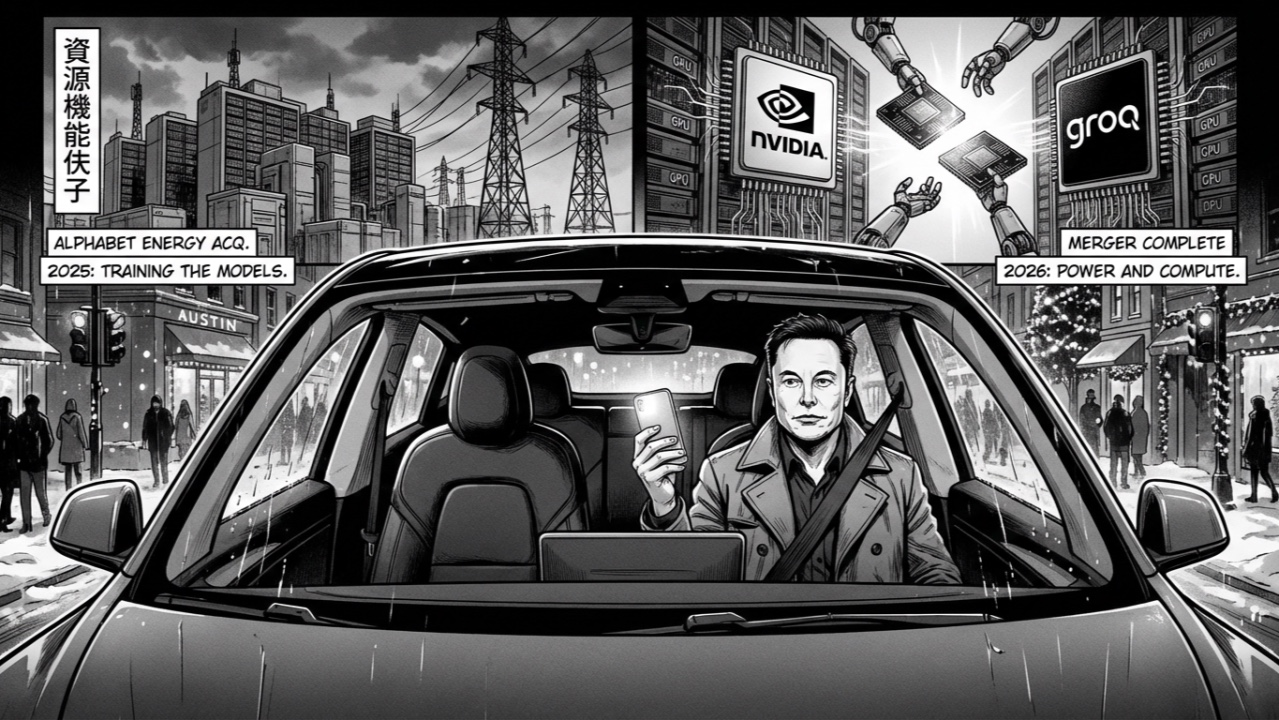
Musk testing driverless robotaxis ON CHRISTMAS. Alphabet buying an energy company for 4.75 billion to solve the problem of powering its AI data centers. Nvidia closing the acquisition of Groq for 20 billion.
2025 was the year of raising billions to train models. 2026 is going to be the year of solving the energy and compute problem. Whoever controls the electricity and the chips will control AI. And Nvidia, Google, and dear Elon know it.
The Musk thing is what blows my mind the most (as usual). The guy gets into a Tesla Model Y on December 24, in Austin, no driver, nobody in the safety seat, and films how the car handles intersections, pedestrians, everything. His AI director does the same. And they share it publicly.
It could be genuine confidence in their system…. or a desperate bet to prove Tesla is still relevant while its stock plunges 40% year to date.
Anthropic and OpenAI giving away AI capacity to devs “for Christmas.” (Much appreciated — my wife, not so much.)
All of this happens in a week when supposedly nobody works.
The music keeps playing. But faster and faster — we’ve gone from a Sam ballad to a full-on rock choir.
THE BOMBSHELL OF THE WEEK
Nvidia buys Groq for $20 billion on Christmas Eve
On December 24, Nvidia bought Groq, a startup making specialized artificial intelligence chips.
The story in simple terms: Groq had raised 750 million in investment three months ago. Nvidia paid 20 billion. That’s almost triple what it was worth.
Why it matters: Imagine Nvidia is the only one selling cars. Groq was building faster, cheaper cars. Instead of competing, Nvidia bought them. Now there’s no competition.
Groq’s chips were the fastest at making artificial intelligence respond (when you ask ChatGPT something, for example). Nvidia already dominated the “teaching” side of AI. Now it also dominates the “using” side of AI.
The result: AMD and Intel, the other chipmakers, are left without options. Nvidia controls the entire AI chip market.
POWER MOVES
Starbucks poaches Amazon’s technology chief
Starbucks has a problem: its coffee shops lose money because the logistics are a mess. Solution: hire the guy who made Amazon Fresh work.
Anand Varadarajan has spent 19 years at Amazon. He built the systems that get your grocery order delivered in two hours. Now he has to apply that same efficiency to 35,000 Starbucks locations.
He starts January 19 as the new technology chief.
GitHub is no longer independent: Microsoft takes control
GitHub is the platform where programmers store their code. Microsoft bought it in 2018 but let it run on its own.
That’s over. GitHub’s CEO, Thomas Dohmke, is leaving to start his own company. Microsoft isn’t going to put anyone in his place. It’s simply going to run GitHub directly as just another division.
Three CEOs fired at Christmas
Companies use the holidays to deliver bad news when nobody’s paying attention:
- Lululemon (athletic apparel): The founder published an ad in the Wall Street Journal criticizing the CEO. The CEO left.
- Kohl’s (department stores): The CEO was doing million-dollar deals with a company owned by his girlfriend. Without telling anyone. Fired.
- MongoDB (databases): CEO change without drama. The new one comes from another software company.
Why does everything happen between December 22 and 30? Because the press is on vacation and nobody notices.
MONEY TALKS
Google buys an electricity company for 4.75 billion
Google has a problem: artificial intelligence consumes enormous amounts of electricity. So much that local utilities can’t supply it.
Solution: buy your own energy company.
On December 22, Google bought Intersect Power for 4.75 billion dollars. It’s Google’s biggest acquisition in years.
The numbers: Intersect produces 20 times more electricity than the Hoover Dam. By 2028, it will have capacity to power entire cities.
Why it matters: Google no longer depends on anyone for power. It builds its own power plants right next to its data centers. No waiting for permits. No depending on others.
Ten startups raise 1 billion in a single day
On December 22, ten young companies raised more than a billion dollars from investors. The biggest:
- Lovable (330 million): A tool for building software without knowing how to code. Now worth 6.6 billion.
- Erebor Bank (350 million): A bank for cryptocurrency and artificial intelligence companies.
- ZeroAvia (150 million): Aircraft engines that run on hydrogen instead of fuel.
The pattern: Almost every company that raised money has something to do with artificial intelligence. And all of them closed the deal before year-end.
Why the rush? Investment funds want to show off good numbers in their annual reports.
Marissa Mayer tries again
Marissa Mayer was CEO of Yahoo. Then she built a company called Sunshine that failed.
Now she’s trying again. On December 23 she raised 8 million dollars for Dazzle, an app that wants to be your personal assistant powered by artificial intelligence.
The investors who lost money with Sunshine will receive 10% of this new company as compensation.
China creates its own state investment funds
The Chinese government is fed up with private investors not betting on Chinese tech companies.
Solution: create public investment funds with billions of dollars.
On December 26, China announced one national fund and three regional ones to finance local tech startups.
The message: if private money won’t invest in Chinese technology, the State will.
PRODUCT SECRETS
ChatGPT and Claude compete even at Christmas
The two most important artificial intelligence companies (OpenAI with ChatGPT and Anthropic with Claude) did the same thing this week: give their customers extra usage for Christmas.
Anthropic announced first that it was doubling usage limits until December 31. Hours later, OpenAI did the same.
They present it as a gift. But it’s a war for every single user. They don’t even rest on holidays.
Elon Musk rides a driverless taxi on Christmas Eve
On December 24, Elon Musk posted a video of himself in a Tesla driving itself. Nobody at the wheel. Nobody in the passenger seat. Just him in the back seat.
The car drove through Austin (Texas) stopping at traffic lights, dodging pedestrians, and turning through intersections. Musk called it “perfect driving.”
The problem: A university student tracked Tesla’s autonomous taxi fleet in Austin. He found only 32 cars. Not the 500 Musk had promised. And fewer than 10 operate at the same time.
Tesla’s stock has fallen 40% this year. Musk needs the robotaxis to work to reverse that trend. But between what he promises and what’s actually there… lies a lot of distance.
Elon Musk’s artificial intelligence enters the Pentagon
xAI is Elon Musk’s artificial intelligence company. This week it signed a deal with the United States military.
The deal: 3 million military and civilian employees of the Department of Defense will be able to use Grok (Musk’s chatbot) starting in 2026.
Fun fact: xAI is building a giant data center in Tennessee. On the roof they’re going to paint “MACROHARD.” It’s a joke about Microsoft (which is called “Micro-soft,” i.e., small and soft).
REAL NUMBERS
December layoffs: few but steady
In December, around 300 people have been laid off at tech companies. The most notable:
- Amazon: 84 people in Seattle
- Mobileye (Intel’s autonomous driving unit): 200 people, mostly in Israel
- Payoneer (online payments): 60 people
- VSCO (photo app): 24 people
The trick: Companies have learned to lay people off “invisibly.” If you cut fewer than 100 people per office, you don’t have to announce it publicly. So they do small but constant layoffs.
Startups are worth less than they claim
When a startup raises funding, it brags about how much it’s worth. But if you try to sell your shares in that startup, you discover the truth.
On average, tech startup shares sell at a 29% discount to what they’re supposedly worth. In other words: if a company says it’s worth 100, you can actually sell your shares for 71.
Winners (their shares are rising): OpenAI, PsiQuantum (quantum computers), Vercel (developer tools)
Losers (their shares are falling): Arctic Wolf, Postman (both have lost 30% of their value)
The market is already voting on who survives 2026 and who doesn’t.
122,000 tech layoffs in 2025
The year’s numbers:
- 2025: 122,549 people laid off across 257 companies
- 2024: 152,922 people laid off across 551 companies
That’s 20% fewer layoffs than last year. Sounds good. But it’s still more than 120,000 people losing their jobs.
VALLEY DRAMA
A startup that quadruples its value in five months
Lovable is a Swedish company making tools to build software without knowing how to code. You tell it what you want and it writes the code.
Five months ago it was worth 1.8 billion dollars. On December 22 it raised 330 million more. Now it’s worth 6.6 billion.
Big companies create their own investment funds
In 2025, 57 large companies created departments to invest in startups. Up from 46 in 2024.
The biggest investment of the year: Meta (Facebook) paid 14.3 billion dollars for 49% of Scale AI, a company that helps train artificial intelligence.
2026 is going to be the year of truth
Investors predict that 2026 will separate the companies that survive from the ones that die.
Many investment funds that started in 2021 (when money was cheap and everything went up) are in trouble. They invested in companies that haven’t turned a profit and now can’t return money to their investors.
The new bar: Investors no longer want “promising ideas.” They want companies that are already selling and making money. If you don’t have real customers, you don’t get funded.
Artificial intelligence will stop being special
One analyst predicts that by the end of 2026, nobody will talk about “artificial intelligence companies” as a separate category.
Why? Because ALL companies will use artificial intelligence. It will be like talking about “companies that use the internet.” Distinguishing them no longer makes sense.
And that’s it.
Thanks for reading me, and happy 2026.