MY TAKE
Good morning. I’m running late this week, but stay with me — it’s worth it.
I’ve written here before that the most important cultural shift in an industry is not the one that gets decreed, but the one that becomes acceptable to say out loud. And this week it’s become very obvious — as I’ve been saying in this somewhat politically incorrect newsletter — what is actually happening.
This past Thursday, Cloudflare reported Q1 results: $639.8 million in revenue, +34% year over year, an all-time record.
And that same day it announced the layoff of 1,100 employees — 20% of its workforce.
Twenty percent.
Matthew Prince, its CEO, didn’t reach for the usual “this is an efficiency adjustment” script… not at all… he said, exactly:
“Today we are not doing a cost-cutting exercise or an assessment of individual performance. We are defining how a high-growth company operates and creates value in the era of agentic AI.”
Internal AI usage at Cloudflare has grown 600% in three months. The stock fell 24% on the day — not because of the layoffs, but because of the Q2 guidance.
In other words, what he’s saying amounts to: “these roles are obsolete, not bad.” Pack up your knives and go.
That same day, Dennis Woodside, CEO of Freshworks, said during the earnings call:
“More than half of our code is already written by AI.”
And he laid off 500 people, 11% of the workforce, with revenue growing at 16%. And Hayden Brown, CEO of Upwork — the marketplace for tech freelancers — laid off 24% of her workforce because “AI is reducing demand for the work our platform intermediates.”
A company whose business model depends on matching freelance supply and demand is laying people off because AI itself no longer needs that match.
The Tinder of devs is in danger.
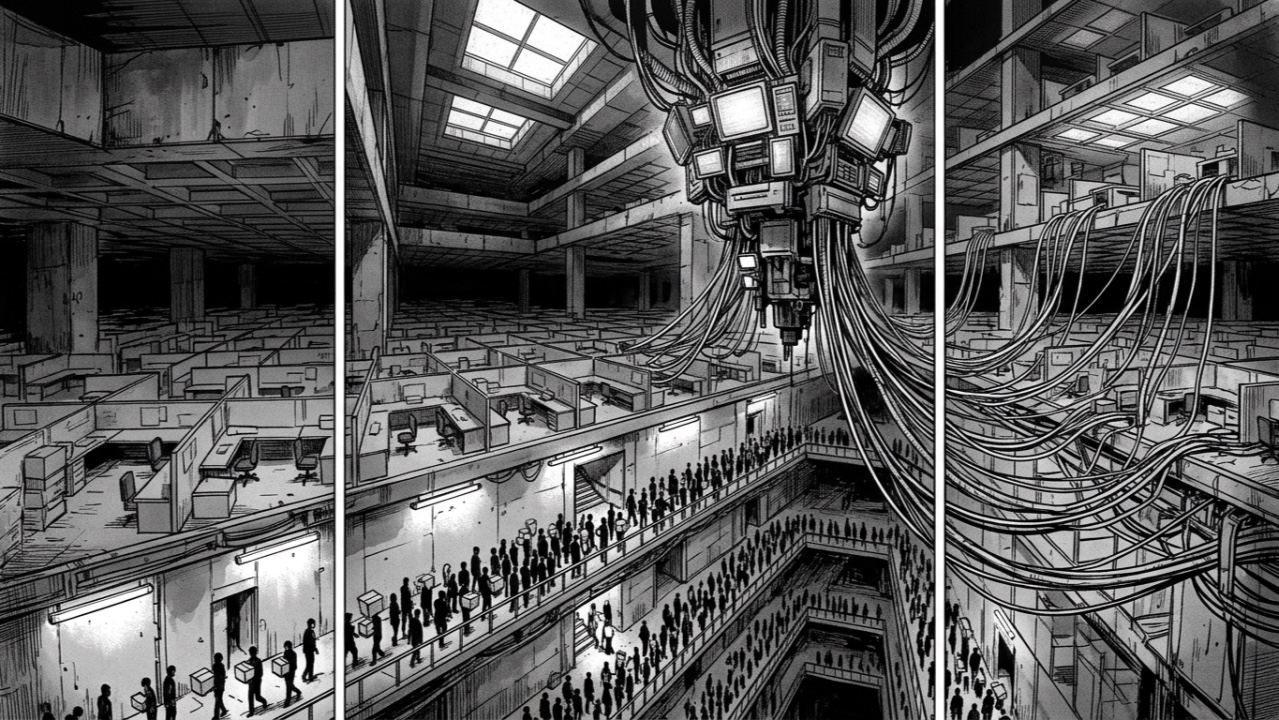
What strikes me as structural is not the data point. What’s structural is the change in tone. Six months ago, saying “AI does this job better” on an earnings call was admitting defeat. Today it’s admitting discipline.
Six months ago, CEOs talked about “talent redistribution.” Today they talk about “obsolescence.” And the market keeps rewarding it. When Prince, Woodside and Brown say it this week, analysts applaud like there’s no tomorrow.
This has an immediate consequence for anyone making headcount decisions in 2026-2027: the reputational cost of laying people off because of AI just dropped to zero. What six months ago required a defensive press release and a briefing note for analysts is today told with pride. And if the big players tell it with pride, the mid-sized ones will copy it. And so will the small ones.
And while this happens, in another corner of the same Silicon Valley, Anthropic posted its most impressive number yet: 80x year-over-year growth in Q1, with a $30 billion ARR run rate as of April. Dario Amodei publicly admitted they had sized the plan for 10x growth, and that the 80x is the reason they’ve had “compute difficulties.”
Which is why, on Tuesday May 6, Anthropic signed a deal to rent little Elon’s supercomputer — the entire Colossus 1, with 220,000 Nvidia GPUs and 300 megawatts.
Musk’s public line on closing the deal: “my spidey sense was not triggered by these guys.”
This is where the week connects. The normalization of AI layoffs and Anthropic’s capacity sprint are the same story seen from two sides. On one side, mid-sized software companies are compressing headcount because they can do the same with fewer people and more compute. On the other, the two or three companies selling that compute and those models are reaching growth speeds without precedent in the history of software. It’s a massive transfer of capex from human salaries to inference contracts. The number quoted this week — $725 billion in 2026 — is the approximate magnitude of the flow toward four companies: Nvidia, Microsoft/Azure, Google Cloud and AWS.
And in between, OpenAI testifies under oath. Its ex-CTO says the CEO lied to her. While Anthropic, according to multiple sources this week, prepares an IPO in June.
Phew. The ground is starting to move under our feet. And if you’re not in software engineering and think your profession is safe, you’re wrong.
They started with the most complex profession, because it’s the one that moves the most money. That’s the only reason.
You know that if you enjoy this weekly newsletter, the best thing you can do is comment or repost it. Likes are appreciated, but they don’t have the same impact.
And if you want the full detail, I’ll leave you with my minions…
THE BOMBSHELL OF THE WEEK
Three days of sworn testimony that demolish OpenAI’s public narrative
The Musk v. Altman case — Elon Musk’s lawsuit against OpenAI alleging breach of the nonprofit’s founding terms — entered its second phase of testimony this week. And what it produced in five days rewrites the public narrative of the most highly valued company in AI.
Timeline of the week:
- Tuesday, May 6. Mira Murati, OpenAI’s ex-CTO, testifies by video deposition. Under oath, she states that Sam Altman told her the legal team had approved the launch of a new model without going through the deployment safety board. When counsel asks whether Altman was telling the truth, Murati answers: “No.” In the same deposition, she describes Altman “pitting executives against each other” and says the company was “at catastrophic risk of disintegrating.” (US News , Gizmodo )
- Wednesday, May 7. Shivon Zilis — former OpenAI board member, Neuralink executive and mother of several of Musk’s children — takes the stand. She produces text messages showing Musk trying to recruit Sam Altman to build an AI lab inside Tesla and offering him a Tesla board seat. Other messages show Musk asking Andrej Karpathy for “a list of OpenAI’s best people to poach.” (CNBC )
- Thursday, May 8. Bloomberg headlines: “Musk and Altman’s management styles come under fire.” OpenAI counterattacks by questioning Musk’s motives. MIT Technology Review publishes its recap of week two of the trial. (MIT Technology Review , Bloomberg )
The signal: OpenAI is trying to go public at a valuation approaching one trillion dollars while a jury weighs whether its founding structure was fraudulent and its ex-CTO testifies under oath that the CEO lied to her. Any underwriting bank that signs the S-1 with this public record will have a lot of explaining to do to its regulators. And the only major rival — Anthropic — is this very week accelerating its own pre-IPO sprint. The operational question is not whether OpenAI goes public in Q4. It’s whether the board — what’s left of it — still believes it goes public in Q4 after this week’s depositions.
POWER MOVES
DeepMind London votes 98% to unionize — and Google runs out of tactical room
On May 5, Google DeepMind employees in the UK voted 98% in favor of unionizing through the Communication Workers Union (CWU) and Unite the Union. They gave management 10 working days to voluntarily recognize the unions before starting a statutory recognition process. (Fortune , Gizmodo )
The direct trigger: Google’s recent agreement with the US Department of Defense to integrate Gemini into classified military networks. More than 600 employees signed an open letter opposing the deal. The unionists’ demands: (1) an independent ethics oversight body, (2) an individual right to refuse morally objectionable projects, and (3) restoration of Google’s public commitment against developing AI weapons. (Engadget , The Hill )
Why it matters: UK labor law gives this vote real legal teeth. Google is now managing a potential statutory union recognition process over its most strategically critical AI team, precisely when that team needs to execute the Pentagon contract. Every European press cycle over the next six months will cite that 98% vote as a data point.
The Pentagon signs with eight companies — and labels Anthropic a “supply chain risk”
On May 3, it became public that the US Department of Defense closed classified AI integration agreements with eight companies through the GenAI.mil platform: Google, Microsoft, AWS, Nvidia, OpenAI, Reflection AI, SpaceX/xAI and Oracle. (Breaking Defense )
Conspicuously absent: Anthropic. The key detail that emerged this week: the Pentagon designated Anthropic a “supply chain risk” — a label normally reserved for adversarial foreign vendors like Huawei — after Anthropic refused to allow its models to be used for domestic surveillance of US citizens and for autonomous weapons systems without human authorization. Anthropic and the DoD are now in active litigation, with a judge granting Anthropic an injunction against the designation while the case proceeds. (CNN )
Why it matters: being excluded from eight classified contracts is a short-term hit to Anthropic’s public-sector revenue. But the “supply chain risk” designation is a reputational and legal weapon the DoD rarely uses against American companies. On the flip side, the eight companies that signed have just publicly committed their models to military uses with no declared restrictions. That is exactly the opening Anthropic is using to differentiate itself in enterprise sales and, above all, with European regulators in the middle of AI Act negotiations. This week the two games — US and EU — fully forked.
MONEY TALKS
Sierra closes $950 million at a $15.8 billion valuation — Bret Taylor consolidates the enterprise layer
On May 4, Sierra — the enterprise AI agents company founded by Bret Taylor (ex-co-CEO of Salesforce and current OpenAI chairman) — closed a $950 million round led by Tiger Global and Google Ventures, with Benchmark, Sequoia and Greenoaks participating. Post-money valuation: $15.8 billion. Sierra claims to serve more than 40% of the Fortune 50 and to process billions of interactions across insurance, banking and mortgages. (TechCrunch , CNBC )
The signal: the customer-service and enterprise-experience agent layer has decoupled from the rest of the AI application market. Sierra no longer competes against agent startups; it competes directly against Salesforce Agentforce and ServiceNow. That Google Ventures leads this round, alongside Tiger, signals Google sees Sierra as a complementary channel to Gemini Enterprise — not as competition. The battle for the application layer is not just between hyperscalers. There is a mid-tier capitalized at $16 billion that will compete from independence.
OpenAI and Anthropic launch parallel vehicles to sell AI to companies via private equity — on the same day
The coincidence is too precise to be chance. On May 4:
- OpenAI finalized “The Deployment Company,” a joint venture that has raised more than $4 billion from 19 investors, including TPG, Brookfield, Advent, Bain Capital, SoftBank and Dragoneer. Pre-money valuation: $10 billion. The entity gives direct access to more than 2,000 companies in the participating PE portfolios. OpenAI retains majority and operational control. (Bloomberg )
- Anthropic launched its own parallel $1.5 billion joint venture with Blackstone, Hellman & Friedman and Goldman Sachs. The structure embeds Anthropic engineers inside portfolio companies to redesign workflows around Claude, in direct competition with traditional consulting. (TechCrunch , Anthropic , Blackstone )
The signal: the two frontier labs have simultaneously reached the same conclusion — that the next phase of AI monetization doesn’t run through the traditional enterprise sales channel, but through the private equity channel. The reason is geometric: Blackstone, Bain, TPG, Advent, Brookfield and Hellman & Friedman together control thousands of portfolio companies that urgently need AI agents to sustain multiples in upcoming exits. Whoever owns that channel owns deployment as a defensive moat, before the underlying models become a commodity. The bet is that Accenture and Deloitte won’t get there in time.
Moonshot AI raises $2 billion at $20 billion — the post-DeepSeek Chinese sprint
On May 7, Moonshot AI — maker of the Kimi chatbot in China — closed $2 billion led by Meituan’s VC arm (Long-Z Investments), with Tsinghua Capital, China Mobile and CPE Yuanfeng participating. Valuation: over $20 billion. Moonshot reported $200 million ARR as of April 2026 and has raised $3.9 billion in the last six months, making it the most heavily capitalized Chinese LLM startup. (TechCrunch , Bloomberg )
The signal: DeepSeek’s open-source disruption has paradoxically benefited well-capitalized Chinese closed-model vendors. When open weights increase aggregate demand for inference compute, the platforms that can offer enterprise-SLA hosting capture the upside. It matters for the European market: the corridor of competitive non-Western models is consolidating at speeds the AI Act still hasn’t absorbed into its assumptions.
Cerebras raises its IPO range to $125-135 — the biggest tech listing of the year
Cerebras filed its amended S-1 on May 4, setting an initial range of $115-125 per share (28 million Class A shares, $3.5 billion target, $26.6 billion valuation). On May 8 it raised the range to $125-135, implying a valuation close to $28.5 billion. OpenAI appears as a key customer in the S-1. (TechCrunch , GuruFocus )
The signal: Cerebras is the first real public test of investor demand for AI inference hardware that isn’t Nvidia. If the range holds or rises at the open, it opens the door to a wave of chipmaker IPOs (Groq, Tenstorrent) that have been waiting two years for a window. If the range falls short, the “Nvidia alternative” thesis loses the main financial channel sustaining it.
PRODUCT SECRETS
Anthropic signs with SpaceX for all of Colossus 1 — and doubles Claude Code limits the same day
On May 6, Anthropic announced it had signed with SpaceX for access to the entirety of the Colossus 1 supercomputer (Memphis, TN): 300 megawatts, more than 220,000 Nvidia GPUs. The agreement also includes exploratory terms for gigawatt-scale orbital compute infrastructure. Immediate user-visible effect: Claude Code’s five-hour limits have doubled for Pro, Max, Team and Enterprise plans; peak-hour throttling on Pro/Max has been eliminated. (Anthropic , CNBC , Axios )
Competitive analysis: the most nuanced comment of the week came from Simon Willison: a company explicitly positioned as the safe alternative to Musk’s AI just became his biggest compute customer. The move is operationally necessary — Anthropic admits it had “compute difficulties” after growing 80x year over year — but strategically complex. For SpaceX, having Anthropic as a named customer reinforces its “AI infrastructure” thesis right before the expected IPO roadshow. For Anthropic, it raises the question of how far the “safety-first” narrative can hold when its operational dependency runs through Musk. (Simon Willison )
Bullish buys Equiniti for $4.2 billion — the first serious bet on tokenized securities infrastructure
On May 5, crypto exchange Bullish agreed to acquire Equiniti — the British transfer agent serving some 3,000 issuers and 20 million shareholders, processing $500 billion in annual payments — from PE firm Siris Capital for $4.2 billion ($1.85 billion in assumed debt + ~$2.35 billion in Bullish shares at $38.48). Expected close: early 2027. Combined 2026E adjusted revenue: $1.3 billion. (Bullish , Bloomberg , CoinDesk )
Competitive analysis: this is the most consequential deal of the cycle in tokenized securities infrastructure. Bullish is positioning Equiniti as the global transfer agent for blockchain-native capital markets. If the deal closes on the announced terms, it locks in a regulated UK position for Bullish with existing relationships across nearly every significant FTSE issuer. What to watch next: how Computershare and Broadridge react — the two big transfer agents that have dominated that segment for decades without serious technological competition.
REAL NUMBERS
Cloudflare (Q1 2026, reported May 7):
- Revenue: $639.8M (+34% YoY, all-time record)
- Layoffs announced the same day: 1,100 people (20% of workforce)
- Growth in internal AI usage: +600% in three months
- Severance: full base salary through the end of 2026 for everyone leaving
- Stock reaction: -24% on the day (on Q2 guidance, not the layoffs)
- CEO’s phrase: “these roles are obsolete” — not “redundant” or “inefficient”
Implication: when honesty about substitution becomes a positive signal for investors, the reputational cost of admitting it publicly drops to zero. (TechCrunch , CNBC )
Freshworks (Q1 2026, reported May 5):
- Revenue: $228.6M (+16% YoY)
- Net loss: $4.8M
- Layoffs announced the same day: 500 people (11% of workforce)
- CEO Dennis Woodside’s confession, live on the earnings call: “more than half of our code is already written by AI”
Implication: the phrase “half our code is written by AI” is the quote that will appear in every board deck about engineering headcount for the next 24 months. It’s the standardized operational justification. (Storyboard18 , Benzinga )
Anthropic — the numbers made public this week:
- Q1 2026 growth: 80x year over year (self-reported, stated by Dario Amodei this week)
- ARR run rate as of April 2026: $30 billion
- Reported gross margin: 70%
- Compute just contracted (May 6): 220,000 Nvidia GPUs / 300MW (all of Colossus 1)
- Public admission by the CEO: the plan was sized for 10x growth; the 80x is the cause of the “compute difficulties”
Implication: 80x velocity breaks every known infrastructure planning model. That’s why the only viable short-term option was to rent the largest capacity available on the open market — even if it was Musk’s. (Fortune , VentureBeat )
Tech layoffs, 2026 running total (as of May 9):
- 286 companies
- 128,270 employees
- Pace: 1,002 per day
- Redirected capex (247 Wall St. estimate, May 7): $725 billion in 2026 toward four companies (Nvidia, Microsoft/Azure, Google Cloud, AWS)
Layoffs announced this week alone:
- Cloudflare: 1,100 (20%) — May 8
- Freshworks: 500 (11%) — May 5
- Upwork: 145 (24%) — May 7
- BILL: up to 30% of the workforce — May 5
- Cognizant (“Project Leap”): internal review of 12,000-15,000 globally — May 6, with India absorbing the bulk
- Build a Rocket Boy: 170 (68%) — this week
- 0G Labs: 10 (25%) — this week
Implication: the substitution wave is moving from product-software companies to IT services companies. If Cognizant executes the 15,000 under Project Leap, the next reporting window (Q2 2026) will bring similar moves at Infosys, Wipro, HCL and Accenture. (247 Wall St. , Yahoo Finance , Upwork , DQ India )
VALLEY DRAMA
Anthropic rents compute from Musk — the strangest détente of the year
Anthropic’s public narrative for months has been: we are the “safety-first” lab, the adult, responsible alternative to Musk’s AI. That narrative produced the $1.5B JV with Blackstone, Hellman & Friedman and Goldman Sachs closed last Monday (covered in the money section). It’s a narrative that sells. And it has worked.
This week, however, that narrative collided with operational math. Anthropic grew 80x year over year in Q1. The plan was sized for 10x. The difference demands compute that doesn’t exist on the open market in the short term… except Colossus 1. And Colossus 1 belongs to SpaceX/xAI. That is, to Musk.
On Tuesday May 6, Dario Amodei signs. Claude Code limits double the same day. Musk posts: “no one set off my evil detector.” The implied price of the deal — 220,000 Nvidia GPUs and 300MW for a year — brings Colossus 1 close to operational breakeven, which directly benefits SpaceX’s pre-IPO valuation. (Tom’s Hardware )
Estimated impact: the real cost to Anthropic is not financial, it’s narrative. Any pitch to a European sovereign fund or a governance-sensitive enterprise buyer will have to answer, for the next six months, why the “safe alternative” operationally depends on the infrastructure of the person it positioned itself against. The operational answer is legitimate — “we grew 80x and there was no alternative” — but it leaves a mark. What this proves is that in 2026 compute is the hard constraint, and brand purity yields to it. Anyone who hasn’t internalized that in their strategic thesis is still operating with old playbooks.
THE WEEK AHEAD (May 11-17)
Earnings with executive consequence:
- Cisco (CSCO) — Q3 FY2026, Tuesday May 13, 4:30pm ET, after the close. Watch: comments on enterprise AI networking demand, GPU cluster interconnect, and any guidance change on AI-driven capex. Cisco is the best mid-cap proxy for non-hyperscaler AI spend. (StockTitan )
Regulatory:
- EU Digital Omnibus AI — third trilogue, Wednesday May 13. Formal negotiating session moving toward adoption of the AI Act amendments provisionally agreed on May 7. The May 7 agreement already deferred high-risk AI compliance to 2027/2028 and mandatory watermarking to December 2026. If friction points remain — especially on GPAI obligations — they surface here. (Consilium EU )
Product launches:
- Google I/O 2026 — May 19-20 at Shoreline Amphitheatre, Mountain View, with a pre-recorded preview on YouTube on May 12 (inside next week’s window). Expected: Gemini 4 (2M-token context, native image/video generation), Android 17 AI Core API for on-device inference, the debut of Aluminium OS, a Project Astra update. It’s Google’s most consequential I/O in five years, given the competitive pressure from Anthropic and OpenAI on Gemini 4. (Android Authority )
IPO pipeline:
- Cerebras (CBRS). Active roadshow. Expected debut between May 12 and 16 depending on book-building demand. Current range: $125-135 per share.
Court proceedings:
- Musk v. Altman — week 3 of testimony. Expected: current OpenAI executives defending the for-profit transition, and possibly Sam Altman in person (unconfirmed at press time). Any new deposition about the safety board could alter the IPO timeline.
Thanks for reading.