MY TAKE
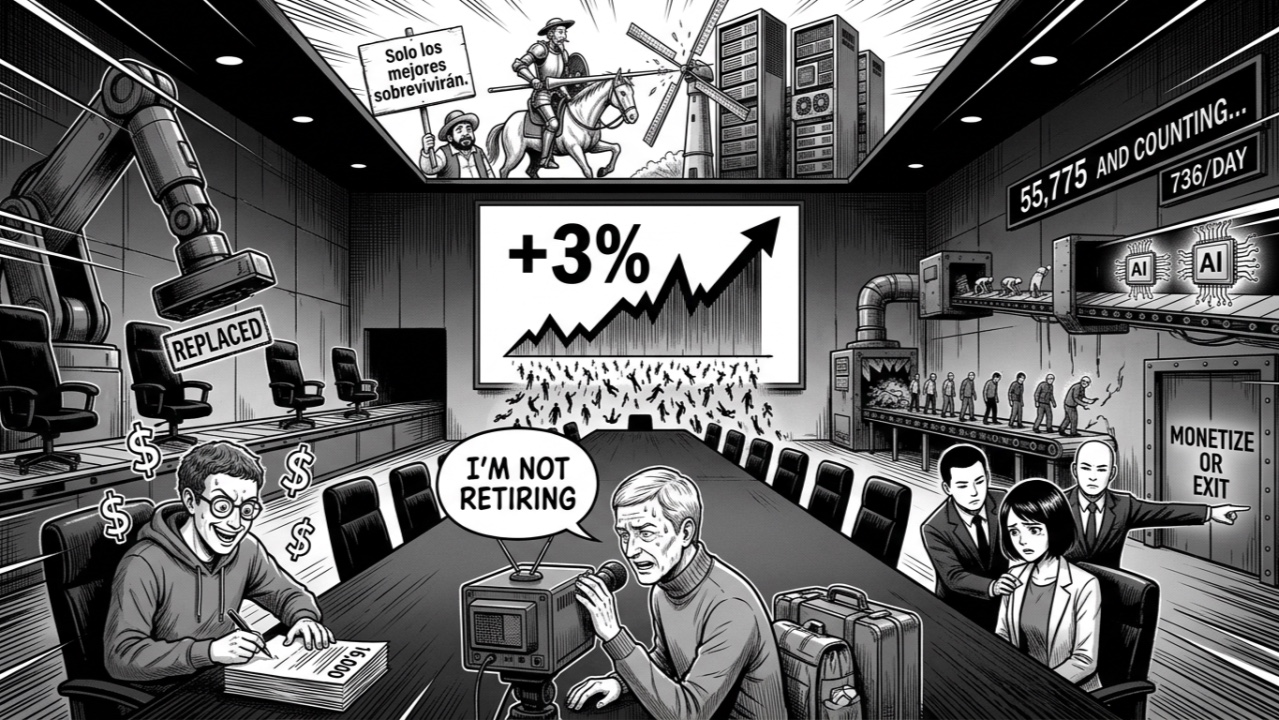
Arch-villain Zucky, Sam Altman’s daily inspiration, wants to lay off 16,000 people. The market goes and rises 3%… and we move on….
Tim Cook goes on television to deny he’s retiring, which means he’s definitely retiring….
The CIO of CISA, the agency that defends America’s critical infrastructure, leaves because they tried to reassign him and he’d rather go. And Bluesky’s founder steps down from the top job because investors want someone who knows how to make money (a quality that tends to be hard to find).
Sammy launches GPT-5.4 mini and nano at fire-sale prices: $0.20 per million input tokens on nano.
Watch this closely — at that price, the agentic story gets much better. If you can take screenshots fast and cheap, we’re going to see a substantial improvement in a lot of agents that, say, study a platform’s UX, and things like that.
NVIDIA unveils NemoClaw to turn OpenClaw into the enterprise infrastructure for AI agents. I’ve been losing my whole morning to it. Here’s the official repo
OpenAI buys Astral, the company behind Ruff and uv, the tools millions of Python developers use every day.
Nvidia absorbs Groq, its main competitor in inference, for $20 billion in a deal Congress already wants to investigate, because it smells like an antitrust problem.
This week’s pattern isn’t subtle. It’s… I’d almost say quixotic.
Big tech companies are simultaneously executing two moves that seem contradictory but are perfectly coherent: drastically reducing the number of people they employ while building the infrastructure for AI to do their work.
Meta isn’t laying off people and spending $135 billion on AI.
It’s laying off people BECAUSE it’s spending $135 billion on AI. And the proof is on its own platform: this week they confirmed their AI systems detect twice as much rule-violating content as human moderators, with 60% fewer errors.
This is no longer narrative. It’s operations. It’s money.
What worries me isn’t AI replacing jobs — those of you who’ve been reading me for months already know that.
What worries me is the speed at which Wall Street has decided that replacing humans is the right metric for measuring success. When the market rewards mass layoffs with 3% jumps, the incentive is clear: the CEO who doesn’t fire fast enough is destroying shareholder value. And that creates a cascade effect where every board of directors takes notes.
55,775 tech layoffs so far in 2026. 736 people a day. And 20% of those layoffs are already explicitly attributed to AI. It’s March.
Let’s put it in perspective: according to CompTIA, net tech employment in the US is roughly 9.6 million people.
The question nobody wants to ask out loud: if these companies are so convinced AI can do the work, why do they keep hiring AI engineers at $500,000 a year?
Because the reality is that AI doesn’t replace employees — it replaces certain types of employees. The one who stays has to be exponentially better. And that’s a talent problem no mass layoff solves.
We’ve lived through a happy era these past 50 years, where we managed to flatten the bell curve of the human species considerably, giving everyone the same opportunities. But we ourselves are about to put it back where it’s been for the last few thousand years.
Only the best and most adapted will survive to sustain the standard of living we know today.
Everyone else will get a state stipend, an AI companion partner, a Netflix subscription…. and will be happy.
It’s awkward to ask, but if you want me to keep bringing you up to speed and giving you my “valuable” opinion, recommend me — it’s free. Comments also help A LOT :)
Now, if you keep going… all the detail.
THE BOMBSHELL OF THE WEEK
Meta plans to lay off 20% of its workforce while spending $135 billion on AI. Wall Street applauds
On March 14, Reuters revealed that Meta executives have instructed senior directors to begin planning layoffs that would affect more than 20% of the company’s 79,000 employees. That’s roughly 16,000 jobs. It would be Meta’s biggest cut since the 11,000 layoffs of November 2022.
The timeline:
- March 14: Reuters publishes the story citing three senior internal sources. Meta spokesperson Andy Stone calls it a “speculative report about theoretical approaches.”
- March 16: Meta shares rise nearly 3% in premarket. CNBC confirms the story with its own sources.
- March 17: Fortune connects the layoffs to a broader pattern: the same week, Meta announced it would replace thousands of human content moderators with AI systems.
- March 19: Bloomberg and CNBC confirm Meta is deploying AI for content moderation that detects twice as much violating content as human teams, with 60% fewer errors.
What the press isn’t telling you. These two stories are actually the same story. Meta isn’t simply cutting costs. It’s running a live experiment in substituting human cognitive labor at scale, using its 3.2-billion-user platform as proof of concept. Content moderation is the pilot. The 20% layoff is the scale-up. No other company in the world has the distribution to test AI-for-human substitution at this magnitude.
The numbers that matter. At an average total compensation of roughly $250,000 per employee, 16,000 layoffs represent about $4 billion in annual savings. That funds roughly 3% of the $135 billion AI capex. The math says the layoffs aren’t primarily to fund AI — they’re to show Wall Street that AI replaces headcount, not just complements it.
The signal: The market has established a new social contract with big tech: we reward you if you fire and spend on AI, we punish you if you keep headcount. That incentive will shape every headcount decision in Silicon Valley over the next 12 months.
Sources: Reuters/TechCrunch, March 14 | CNBC, March 16 | CNBC, March 19 | Fortune, March 16
POWER MOVES
Tim Cook denies retirement on television — Apple’s succession enters its public phase
On March 17, Tim Cook appeared on Good Morning America to deny the retirement rumors: “That’s a rumor. I can’t imagine life without Apple.” He did not confirm future plans.
This is not a non-event. That Cook chooses a morning TV show — not a shareholder letter, not an earnings call, not an internal memo — to address the question is a stabilization maneuver. The underlying facts haven’t changed: the Financial Times reported he planned to leave in early 2026, he turned 65 in November, John Ternus was given design oversight in January, and Apple has completed its biggest executive exodus in years (Jeff Williams retired, Alan Dye to Meta, John Giannandrea out). Cook denies on GMA to stabilize perception ahead of Apple’s 50th anniversary in April — not as a definitive statement of timeline.
The signal: Ternus at 50 is the same age Cook was when he succeeded Jobs. The prediction markets and Bloomberg’s sources remain active on the succession. The public denial, paradoxically, confirms the conversation is real.
Sources: CNBC, March 17 | MacRumors, March 17
CISA’s CIO walks — the agency defending America’s critical infrastructure is left leaderless
Robert Costello, CISA’s CIO after 23 years in federal government, left the agency during the week of March 17-19. He refused transfer orders and chose to leave. On March 19 he was announced as Chief Digital and Information Officer at Merlin Group.
Costello’s exit is the latest senior casualty in CISA’s leadership collapse under the Trump administration. Within weeks: acting director Madhu Gottumukkala was removed, the key leaders of the Secure by Design initiative resigned, the head of threat-hunting left for the private sector, and now the CIO has walked. The agency that defends US critical infrastructure from cyberattacks is running on acting officials at every level.
The signal: For tech leaders with federal contracts, government supply chains or critical infrastructure exposure, CISA’s operational continuity is now a genuine risk factor, not just a political story. And this right before RSA Conference next week.
Sources: CyberScoop | PR Newswire, March 19 | MeriTalk
Jay Graber steps down as Bluesky’s CEO — the search for a commercial chief begins
On March 19, coinciding with the reveal of the $100 million Series B, Jay Graber announced her transition from CEO to “Chief Innovation Officer.” Bluesky is looking for a CEO with commercial experience. 43 million users, zero revenue, and a board that has decided the building phase is over and the monetization phase must begin.
The signal: When the founder moves to “innovation” and the board seeks a commercial profile, the message is clear: investors want to see a path to revenue before the $100 million runs out. The question is whether Bluesky can monetize without betraying the decentralization promise that made it relevant.
Sources: TechCrunch, March 19 | Bluesky Blog, March 19
MONEY TALKS
Nvidia-Groq: the $20 billion deal Congress wants to investigate
On March 20, Senators Warren and Blumenthal sent a letter to Jensen Huang demanding answers about Nvidia’s $20 billion agreement with Groq, closed on December 24, 2025. The deal grants Nvidia a perpetual, non-exclusive license over Groq’s entire patent and software portfolio, and transfers the founding leadership — including CEO Jonathan Ross — and its core engineering team to Nvidia.
The numbers:
- Groq’s Series D valuation (August 2024): $2.8 billion
- Groq’s Series E valuation (September 2025): $6.9 billion
- Nvidia’s offer: $20 billion — a 3x multiple on the September valuation and 7x on the August one
Nvidia calls it a “non-exclusive licensing agreement.” Critics call it a de facto acquisition structured to evade Hart-Scott-Rodino antitrust review. Groq was Nvidia’s most credible competitor in inference, with its LPU architecture delivering dramatically higher speeds than GPU-based systems. By absorbing the IP and the key engineers without a formal acquisition, Nvidia has neutralized a competitive threat while setting a precedent for how big tech can consolidate AI infrastructure without regulatory scrutiny.
The signal: If the DOJ doesn’t act, this will be the template for the next wave of AI consolidation — license + talent transfer = acquisition without regulation.
Sources: Bloomberg/Spokesman, March 20 | Yahoo Finance | Groq Newsroom
Cape: $100 million for the mobile carrier the government uses when it can’t trust AT&T
Cape, a mobile carrier built from scratch for government and enterprise security, closed a $100 million Series C led by Bain Capital Ventures and IVP. Post-money valuation: $900 million. The company is 3 years old.
The reality behind the PR: Cape is not a consumer privacy product. Its main traction is with national security agencies, government contractors, journalists and executives who need to operate beyond the surveillance reach of traditional carriers. That a16z and Point72 are on the cap table — not typical telecom investors — confirms that the non-public government contract pipeline is what justifies the valuation.
The signal: The “post-Snowden private infrastructure” thesis has found product-market fit. At $900 million with 3 years of life, Cape is aiming to become the federal government’s secure communications infrastructure.
Sources: BusinessWire, March 19 | Finsmes
Bluesky reveals its $100 million Series B — raised 11 months ago in secret
Bluesky this week disclosed a $100 million Series B led by Bain Capital Crypto, closed in April 2025. Eleven months of silence. The reveal coincides with CEO Jay Graber stepping out of the operating role to become “Chief Innovation Officer” — the company is looking for a CEO with commercial experience.
43 million users. Zero monetization. The valuation hasn’t been disclosed — if the number were favorable, they would have published it. That Bain Capital Crypto is leading, not a typical social media VC, suggests the long-term thesis is that the AT Protocol becomes infrastructure, not that Bluesky the app becomes a business.
The signal: Bluesky needs a revenue model before the $100 million runs out. The leadership transition is the board’s bet that a commercial CEO can find one. Failure scenario: a well-funded project with no business model. Success scenario: AT Protocol as the open infrastructure layer for social.
Sources: Bluesky Blog, March 19 | TechCrunch, March 19 | GeekWire
PRODUCT SECRETS
OpenAI floods the market with GPT-5.4 mini and nano — the era of the subagent
On March 17, OpenAI launched GPT-5.4 mini and nano. Pricing: mini at $0.75 per million input tokens and $4.50 output. Nano at $0.20 and $1.25. Both run more than twice as fast as GPT-5 mini.
These models aren’t designed to replace human interaction. They’re designed to serve as components inside agentic pipelines — classification, data extraction, code subtasks, screenshot-based automation. At under a dollar per million tokens, OpenAI is commoditizing the infrastructure layer that competitors like Anthropic and Google need to survive.
Implication for CTOs: If you have products using GPT-4 models for high-volume classification or extraction, migrating to nano cuts inference costs by 70-80% with higher throughput. The economic justification for maintaining fine-tuned models at that task scale is now very weak.
Sources: OpenAI | The New Stack | 9to5Google
NVIDIA NemoClaw: the play to become the Red Hat of agentic AI
At GTC on March 16, Jensen Huang unveiled NemoClaw, an open-source security and governance stack that installs on top of OpenClaw with a single command. It adds sandboxing, PII filtering and compliance controls. 17 enterprise partners at launch. Hardware-agnostic — it doesn’t require NVIDIA GPUs.
OpenClaw is the fastest-growing open-source project in GitHub history, with more than 321,000 stars, having overtaken React. The problem was always enterprise adoption: no sandboxing, no compliance controls, no audit trail. NemoClaw is NVIDIA’s bet to own the enterprise adoption layer of the most viral AI agent platform ever created. Huang called OpenClaw “the new Linux” — NVIDIA wants to be what Red Hat was to Linux.
The signal: NVIDIA isn’t after GPU lock-in at the agent layer. It’s after platform governance lock-in. Enterprise contracts will include NemoClaw as the delivery vehicle, capturing value at the compliance layer, not the compute layer.
Sources: NVIDIA Newsroom | TechCrunch, March 16 | Fierce Network
OpenAI buys Astral — the GitHub of 2018, but for Python tooling
On March 20 it was confirmed that OpenAI acquired Astral, the company behind Ruff (the Python linter that has displaced flake8, black and isort by being 10-100x faster) and uv (the package manager). These tools have become critical infrastructure for millions of Python developers.
The parallel with Microsoft buying GitHub in 2018 is not subtle. OpenAI is inserting itself into the Python developer workflow at the tooling infrastructure level — below the model, below the API, at the point where code is written and validated. It’s an early-stage platform move for ownership of the Python developer ecosystem, executed while all the attention is on models.
The signal: Your Python engineering workflow almost certainly uses Ruff or uv today. OpenAI now owns that toolchain. Watch for convergence between Codex and Ruff in H2 2026.
Source: llm-stats.com
REAL NUMBERS
The 2026 tech layoff scoreboard:
- 55,775 layoffs across 166 companies so far this year
- 736 people a day — the current rate
- 9,238 explicitly attributed to AI (20% of the total)
- Annualized rate: ~264,730 — which would surpass 2025’s 245,000
- Meta is planning ~16,000 layoffs (20% of its workforce)
Context missing from the headlines. Net tech employment in the US is 9.6 million according to CompTIA (6.1 million in pure tech occupations, the rest in tech roles within other industries). The 55,775 confirmed layoffs represent 0.6% of the net total in just 80 days. At the annualized rate of ~265,000, the sector would lose 2.8% of its workforce in 2026 — or 4.4% if measured against pure tech jobs. For reference, in the dot-com crash (2001) the sector lost roughly 8% in a year. We’re not there, but the trajectory is worrying.
The data point nobody reports. The 55,775 number understates reality because it only captures announced layoffs at companies that make them public. Private companies, stealth reductions (under 100 people), contractor terminations and performance-managed exits don’t show up. The real headcount reduction is probably 1.5-2x the reported number.
The hiring paradox. While these same companies fire, AI engineer salaries keep rising. Median compensation for senior ML/AI roles at the FAANGs tops $500,000. The market isn’t eliminating talent — it’s redistributing it. The engineer maintaining legacy systems disappears. The one building AI infrastructure multiplies their value.
Funding rounds of the week (March 14-20):
- Cloaked — Series B, $375M. Consumer privacy.
- Frore Systems — Series D, $143M (valuation $1.64B). Cooling hardware for AI.
- XBow — Series C, $120M (valuation $1B+). Autonomous security testing.
- Oasis Security — Series C, $120M. Identity security for AI agents.
- Cape — Series C, $100M (valuation $900M). Private mobile carrier.
- Bluesky — Series B, $100M. Decentralized social.
- Latent — Series A, $80M. AI for healthcare.
- RoboForce — $52M. Industrial robotics.
The pattern: Four of the eight biggest rounds are in privacy/security. The convergence of AI agents operating with elevated permissions, government surveillance concerns and enterprise compliance requirements is driving a security investment supercycle inside the AI funding wave.
Sources: Crunchbase News | Medha Cloud | Computerworld
THE DRAMA
Anthropic vs. the Pentagon: the March 24 hearing could redefine AI safety
The conflict between Anthropic and the Pentagon entered a critical phase this week. Recap: Defense Secretary Pete Hegseth gave Dario Amodei an ultimatum to remove two AI usage restrictions (no mass domestic surveillance of US citizens, no autonomous weapons). Anthropic refused. The Pentagon labeled it a “supply chain risk.” Anthropic filed two federal lawsuits on March 9. OpenAI immediately moved to sign a new Pentagon contract, positioning itself as the “patriotic” alternative.
This week’s developments:
- March 16: Axios reports the tech industry has formally united behind Anthropic — industry groups representing hundreds of companies filed amicus briefs asking for the designation to be paused.
- March 17: The DOJ filed its response calling the designation “lawful and reasonable.” The same day, Axios reports that Amazon, Microsoft and Google — all Anthropic investors — are not backing away from their Anthropic contracts despite Pentagon pressure.
- March 24: A federal judge will hear Anthropic’s request for a preliminary injunction.
What nobody says clearly. If the court doesn’t grant the injunction, every AI company with government contracts will face an implicit choice: comply with “all lawful use” clauses that remove safety restrictions, or lose government revenue. The competitive pressure created by OpenAI’s move — signing a Pentagon contract days after Anthropic’s refusal — makes defection from safety standards structurally incentivized.
The signal: This is how AI safety norms collapse — not through ideology, but through market dynamics. Monday the 24th is the most important date on the AI industry’s calendar.
Sources: Axios, March 16 | Axios, March 17 | Fortune, March 12 | CNBC, March 5
THE WEEK AHEAD
- March 24 — Anthropic vs. Pentagon court hearing. A federal judge rules on the preliminary injunction. If it isn’t granted, expect other AI companies to quietly revise their terms of service for government customers over the next 30 days. It’s the most consequential near-term event in the AI industry.
- March 23-26 — RSA Conference 2026 (San Francisco). The most important cybersecurity event of the first half. After the Trivy news (an open-source vulnerability scanner compromised to distribute malware through GitHub Actions), supply chain security and AI-generated exploits will dominate the debate. Watch for NemoClaw-compatible security integrations.
- March 23 — Transform 2026 (Las Vegas). Focus on workforce and HR tech. Given the “self-funding AI via layoffs” template spreading through the industry, expect announcements from HR tech vendors building AI-powered “workforce optimization” tools — the tools the next wave of companies executing restructurings will use.
- White House regulatory framework. On March 20, the administration published its national AI policy framework asking Congress to preempt all state AI laws that impose “undue burdens.” If legislated, it would eliminate the state-by-state compliance patchwork that was forcing companies to build differentiated AI governance frameworks. Companies that built state-level compliance infrastructure face stranded investment if preemption passes.
- OpenAI IPO signals. The Astral acquisition, GPT-5.4 mini/nano pricing and the positioning as a “desktop super app” read like pre-IPO narrative building. Watch for any sign of an S-1 filing, secondary-market valuation reports, or board announcements.
Onwards. Thanks for reading.
Comments appreciated!