MY TAKE
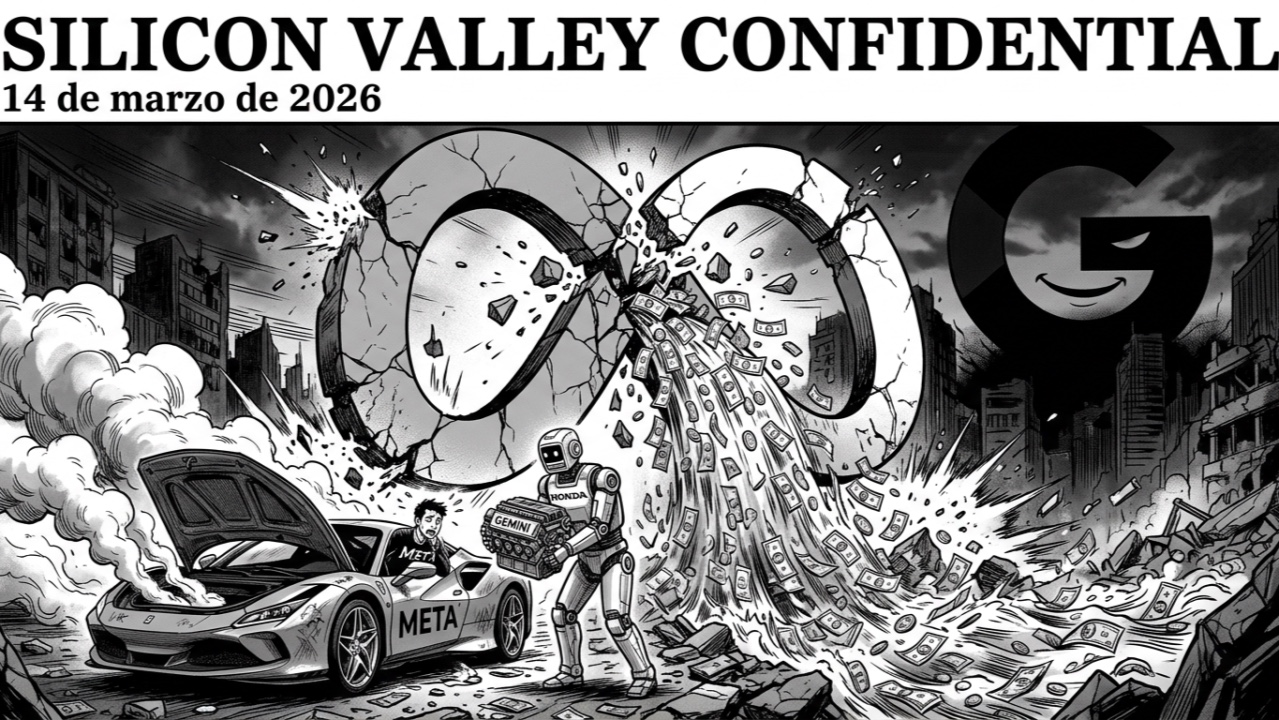
Meta is going to spend $135 billion on AI this year. And this week we learned its flagship model doesn’t work.
That it doesn’t reach the level of Gemini, of GPT-5.4, or of Claude… Zucky must be VERY nervous.
Apparently they’ve discussed licensing Gemini while they fix their own.
$135 billion. With “b” for bonkers.
It’s the equivalent of Ferrari announcing it will invest more than anyone in engines, and then the press catching it calling Honda to borrow one because its own won’t start — although seeing how things are going for Alonso, better to call somewhere else.
But…. they buy Moltbook, the social network for AI bots that had its database wide open with 1.5 million API tokens exposed.
Due diligence is conspicuous by its absence.
And this isn’t just Meta. This week Adobe’s CEO resigned after 18 years. Not because the results were bad — they beat estimates — but because the market has decided that the SaaS “pay per seat” model has its days numbered when an AI agent can do the work of ten people.
The “SaaS-mageddon” is no longer a Twitter meme. It’s the reason a CEO with 18 years of success decides it’s better to leave now.
Atlassian has laid off 1,600 people and its CTO (should I be worried?). The stock went up… they’re getting the hang of it.
But let’s be honest, who’s going to pay for Trello — which on top of everything is slower than the villain’s horse, and eats all your computer’s memory when you use it in the browser. That CTO wasn’t fired because of AI.
The Darden School has academically documented what we all knew: “AI washing” is real, Block’s layoffs had nothing to do with AI, and Wall Street pays a 17% premium for the right narrative regardless of whether it’s true.
This week’s pattern isn’t a company or a CEO.
It’s an entire ecosystem that has decided narrative matters more than reality. Meta spends $135 billion without a competitive model. Adobe loses its CEO with good results. Atlassian fires its CTO and the stock goes up. The market isn’t valuing what is. It’s valuing what sounds good. And that, for anyone making decisions based on fundamentals, should start to make them nervous.
If you want more detail, keep reading. Remember: sharing is caring :)
THE BOMBSHELL OF THE WEEK
Meta spends $135 billion on AI and its model doesn’t work. They’re considering licensing Google’s Gemini.
On March 13, Fortune revealed what may be the most significant story of the quarter in Silicon Valley: Meta Avocado — Zuckerberg’s flagship AI model, the reason Meta has committed between $115 billion and $135 billion of capex for 2026 — doesn’t reach the level of its competitors. It doesn’t reach Google’s Gemini 3.0. It doesn’t reach OpenAI’s GPT-5.4. It doesn’t reach Anthropic’s Claude Opus 4.6.
The launch, planned for March, is delayed until May at the earliest.
But the truly explosive detail is something else: internally, Meta’s AI division discussed the possibility of temporarily licensing Google’s Gemini while Avocado gets up to the required level. No final decision has been made, but the fact that the conversation even happened reveals the magnitude of the problem.
Let’s put it in context. Meta is the company that has bet most publicly on AI. Zuckerberg created Meta Superintelligence Labs (MSL), poaching Alexandr Wang from Scale AI to lead it. It has committed more capex than any other company except Amazon. And its flagship model isn’t ready.
And what Meta did this very week doesn’t reassure either. On March 10, according to Axios , they bought Moltbook, an experimental social network where AI agents interact with each other. The co-founders join MSL on March 16. What didn’t make the press: TechCrunch documented that before the acquisition, Moltbook had its database completely open. 1.5 million API tokens and 35,000 emails exposed to the public. Meta bought a company with a critical security hole. The question is whether they knew and didn’t care, or whether they did no due diligence. Neither option is good.
The signal: The gap between AI capex and the actual capability of in-house models is the risk nobody is pricing. Meta can outspend everyone and still not have a competitive model. If Avocado doesn’t arrive in May, the question investors will ask — “what are the $135 billion for?” — has no comfortable answer. And if they end up licensing Gemini, Meta’s narrative as an AI leader collapses that same day.
POWER MOVES
Caitlin Kalinowski leaves OpenAI: the first executive to break publicly
On March 8, according to NPR , OpenAI’s head of robotics and hardware resigned. It’s not a quiet exit. Kalinowski posted that she left over the Pentagon deal, specifically citing “surveillance without judicial oversight and lethal autonomy without human authorization.” TechCrunch confirmed the details.
She is the first senior OpenAI executive to publicly break with the company over the military deal. According to NPR, she isn’t the only one with internal reservations. The difference is that Kalinowski decided to say it out loud. She came from Meta, where she led Quest hardware. That an executive with that profile chooses the reputational risk of a public exit says more about OpenAI’s internal state than any official statement.
Adobe loses Shantanu Narayen after 18 years
On March 12, CNBC reported that Adobe’s CEO announced his departure. 18 years leading one of the most successful transformations in enterprise software: from perpetual licenses to SaaS, from Creative Suite to Creative Cloud. The stock fell 8% in premarket. Frank Calderoni, an independent director, is leading the successor search with internal and external candidates. Fortune dug into AI pressure as a key factor in the exit.
The timing is no accident. Adobe sits at the epicenter of the “SaaS-mageddon” — the growing fear that agentic AI will destroy the per-seat pricing model underpinning all of enterprise SaaS. The paradox: Q1 results beat estimates. But the market is pricing the future, and the future of “paying per seat” when an AI agent can do the work of ten people is a question Narayen leaves unanswered for his successor.
Atlassian loses its CTO as part of the 1,600 layoffs
Announced March 11: People Matters reported that Rajeev Rajan, Atlassian’s CTO for four years, leaves on March 31 as part of the restructuring that eliminates 10% of the workforce according to CNBC . He came from Meta and Microsoft. Two internal VPs — Taroon Mandhana and Vikram Rao — are being promoted. It’s a delayering signal — removing layers of senior technical leadership — that we’re seeing across the sector. When the CTO leaves along with the layoffs, the message is clear: the transformation isn’t just for those at the bottom.
MONEY TALKS
Nvidia invests $2 billion in Nebius: the loop goes global
On March 11, Bloomberg revealed that Nvidia took an 8.3% stake in Nebius, the European neocloud building AI infrastructure. Nebius shares rose between 15% and 26% according to CNBC . The deal includes early access to the Rubin platform, Vera CPUs and BlueField systems. Nebius has committed 5 gigawatts of datacenter capacity by 2030.
The surface reading: Nvidia diversifies. The real reading: Nvidia is investing in its own customers. Nebius already had deals worth $17 billion with Microsoft and $3 billion with Meta. It’s the same “Great AI Loop” pattern: the money circulates among the same companies. Nvidia invests in Nebius. Nebius buys Nvidia chips. Nvidia books revenue.
But there’s a new angle: Nebius is European. In a context where the Commerce Department wants to control every AI chip on the planet, Nvidia is positioning strategic allies outside the US before the restrictions tighten.
Nexthop AI: $500 million for datacenter networking
On March 10, Nexthop AI closed a $500 million Series B at a $4.2 billion valuation. Oversubscribed. Lightspeed and Andreessen Horowitz led. Founded in 2024. From zero to $4.2 billion in under two years. In networking. Not in models, not in applications — in the cables connecting the GPUs. It’s the “pick and shovel” play of this gold rush, and with $650 billion of hyperscaler AI capex projected, network infrastructure is the next bottleneck.
New unicorns: household robotics and legal tech
Sunday Robotics raised $165 million on March 12 (Series B, $1.15 billion valuation) to build “Memo,” a household humanoid robot. Coatue, Tiger Global and Benchmark led. First pilot deployment planned for Thanksgiving 2026. Household robotics now has its own serious capital cycle.
Legora closed $550 million on March 10 (Series D, $5.55 billion valuation) with Accel. They tripled their valuation since October. More than 800 active law firms across 50 markets. More than 10,000 legal professionals on the platform. Legal AI is no longer a promise: it’s a vertical with real traction and nine-figure checks.
PRODUCT SECRETS
Apple MacBook Neo: $599 and an earthquake in the PC market
Available since March 13 according to Apple Newsroom . $599. A18 Pro chip (yes, an iPhone chip in a laptop). 13 inches, Liquid Retina display, 8 GB of unified RAM. Four colors. Asus’s CFO called it a “shock to the entire market” according to Fortune . It’s the first Mac that competes directly on price with enterprise Chromebooks.
The strategic play isn’t the hardware. It’s Apple’s massive entry into the low-cost education and enterprise segment, right when it depends more and more on Google for Siri’s AI (a $1 billion-a-year deal for Gemini). Apple selling cheap hardware powered by its rival’s AI. The world upside down.
DeepSeek V4: the model that still hasn’t shown up
It’s weeks late. Multiple launch windows have passed without an official release. Reported capabilities: multimodal (text, image, video), a one-million-token context window, optimized for Huawei Ascend chips instead of Nvidia. Sources in Chinese media mentioned a “V4 Lite” on March 9 without official confirmation. The delay coincides with accusations of “AI hijacking” — that DeepSeek copies architectures from Western competitors.
When it drops, the impact will be immediate. If it proves you can train competitive models without American chips, the “Nvidia is indispensable” narrative starts to crack. Watch Nvidia that day.
REAL NUMBERS
45,724 tech layoffs in 2026: 653 a day and accelerating
The running total as of March 14 according to TechNode Global : 45,724 tech jobs eliminated across 81 events. Of those, 9,238 (20%) are explicitly attributed to AI. Average: 653 layoffs a day.
This week:
- Atlassian: 1,600 employees (10%) according to CNBC . 40% North America, 30% Australia, 16% India. Restructuring cost: $225-236 million. The stock goes up.
- Morgan Stanley: 2,500 (March 10).
- Oracle: between 20,000 and 30,000 possible (some sources estimate up to 45,000). No official announcement. Restructuring provisions in SEC filings, but public silence. The real motivation isn’t AI — it’s more than $100 billion of debt and a cash crunch from the Stargate datacenter commitments.
Cities hit hardest in 2026: Seattle (16,590), San Francisco (9,395), Menlo Park (1,500).
The academic study that dismantles “AI washing”
On March 13, the Darden School published an analysis documenting the Block case as systematic AI washing. The data: Block had three rounds of layoffs in 2024 without mentioning AI. The teams eliminated (public policy, DEI) don’t correspond to a technology transition. Jack Dorsey wrapped a classic restructuring in AI wrapping paper and Wall Street rewarded him with +17%. HR Digest confirmed that Atlassian’s layoffs have reignited the debate this week.
The problem now has an academic name. It has a paper. And the conclusion is devastating: the market rewards the AI-first narrative regardless of whether it’s real.
Infrastructure: $700 billion in datacenters in 2026 alone
Hyperscalers will spend nearly $700 billion on datacenters this year. Amazon $200 billion, Alphabet $175-185 billion, Microsoft $120 billion+, Meta $115-135 billion, Oracle $50 billion. Jensen Huang estimates between $3 and $4 trillion by the end of the decade.
If the circular financing stops — and the Meta Avocado case proves that spending doesn’t guarantee results — those $700 billion become the largest write-off in tech history.
THE DRAMA
OpenAI’s internal rift goes public
Kalinowski’s resignation on March 8 has uncovered something that had been brewing for weeks. According to NPR , there are more employees with reservations about the Pentagon deal who haven’t spoken publicly. More than 30 employees of OpenAI and Google DeepMind filed a joint statement of support for Anthropic according to TechCrunch — employees of the company that signed the contract supporting the company that rejected it. OpenAI’s internal social contract — “we work here because it’s different” — is at its most fragile moment.
Meanwhile, the Anthropic vs. Pentagon war goes on. On March 9 they filed two simultaneous lawsuits according to CNBC . Lawfare published an analysis estimating that the designation “won’t survive first contact with the legal system.” And Axios documented how Google, in the smartest move of the week, expanded its DOD contract to 3 million federal employees while everyone was watching the fight. The winner of this war is neither Anthropic nor OpenAI. It’s Google.
Oracle: the silence that screams
Employees on Blind anticipate mass layoffs. Restructuring provisions appear in SEC filings. But the company says nothing publicly. When a company with 162,000 employees stays silent while Bloomberg reports it may lay off up to 30,000, the silence is the news. The debt of more than $100 billion and the Stargate commitment are an unsustainable weight without drastic cuts.
THE WEEK AHEAD
March 16-19 — NVIDIA GTC, San Jose. The most important tech event of the month. Jensen Huang, keynote on Monday the 16th at 11 am PT . Expected: the Rubin architecture in detail (up to 288 GB of HBM4, 5x performance vs. Blackwell), NemoClaw (open source AI agents for enterprises), and confirmation of $26 billion of investment in open source. More than 30,000 attendees from 190 countries. Fortune previewed that last year Blackwell changed the entire industry’s roadmap — this year Rubin could do the same. Every CTO should pay attention.
Oracle — formal layoff announcement. If Bloomberg is right about the 20,000-30,000 figure, it will be the catalyst for a national debate about “AI as excuse” vs. “genuine transformation.” Every day of silence amplifies the uncertainty.
DeepSeek V4 — still pending. When it drops — multimodal, a trillion parameters, optimized for Huawei chips — the market impact will be immediate. Watch Nvidia that day.
Meta Avocado — the clock is ticking. Every week that passes without a launch is another week in which the question “what are the $135 billion for?” gets harder to answer.
Anthropic vs. the Pentagon. Federal courts could issue injunctions this week. If Anthropic wins a quick injunction, it changes the dynamic for all AI companies.
March 19 — Atlassian closes its consultation process. Last day for the 1,600 affected employees to negotiate terms. CTO Rajan leaves March 31. Layoffs effective April 2. And on top of that, it’s my saint’s day.
Thanks for reading.
Onwards