MY TAKE
SpaceX finally went public!
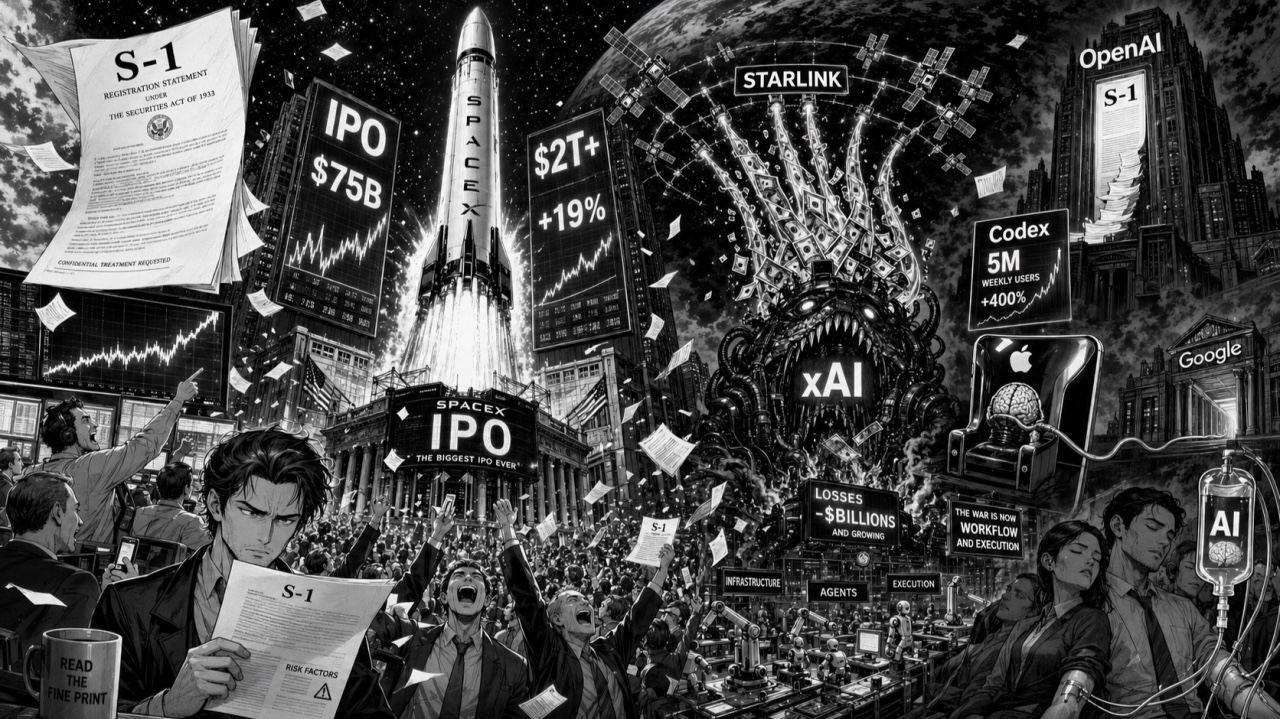
The largest IPO in market history, $75 billion raised, a market cap above two trillion dollars at the close of the first day — and the market chose not to read the fine print. I did read it (well, with Claude’s help, why lie to you), and here’s roughly what I see:
The S-1 confirms that Starlink, with $4.4 billion in operating profit, is financing a consolidated loss of nearly $5 billion caused by the integration of xAI. In plain terms, satellite internet subscribers are paying for Musk’s bet on artificial intelligence — and the stock still jumped 19% yesterday.
We’ve had the same theme for three weeks now:
OpenAI files its confidential S-1 (Jun 8), Apple outsources Siri’s brain to Google for a billion a year (WWDC, Jun 8-9), OpenAI buys Ona to scale Codex (Jun 11), and now SpaceX trades at a valuation for a business that loses billions.
It seems the market has decided to finance the AI narrative above the actual numbers, and it does so with an investor discipline that masks the fact that it’s buying futures, not presents.
For me, the war is no longer about the best model — it’s about the workflow. Codex reports 5 million weekly users and 400% growth so far this year, and that’s why OpenAI is buying agent-execution infrastructure. The money is showing up where the agent replaces work, not where it chats.
Obvious to many of you, surely, but not to everyone.
When Apple admits it can’t (won’t) build its own AI and rents Google’s, the message for any CTO is that technological sovereignty has a price almost nobody can pay — and that dependency is going to be the new normal.
Soon we’ll all be hooked up to the drip, and please don’t let it disconnect, because the two undegraded neurons we’ll have left, we’ll need them to survive.
If you want more detail, I’ll leave you with my minions.
Remember that comments, subscribing, reposting — whatever it is — helps me reach more people.
I’m counting on you.
THE BOMBSHELL OF THE WEEK
SpaceX debuts on Nasdaq: the biggest IPO in history, +19% on day one, and a $5 billion xAI hole hidden in the S-1
On June 12, SpaceX (ticker SPCX) began trading after the largest market debut ever recorded, surpassing Saudi Aramco’s 2019 record. But the debut wasn’t the important part: it was what the prospectus revealed and the market decided to ignore.
Timeline:
- June 11 (after close): SpaceX prices at $135 per share, offering 556.6 million shares to raise ~$75 billion.
- June 12 (first day): opens at 150, intraday peak at 176.52 (+31% over the offering price), and closes at 160.95 (+19%). Market cap tops $2 trillion.
The S-1 numbers that didn’t make the headlines:
- Starlink generated $11.4 billion in 2025 revenue (61% of the total), with $4.4 billion in operating profit.
- The consolidated business reported a loss of nearly $5 billion in 2025, attributed directly to the integration of xAI — acquired in February 2026 in an all-stock deal valued at ~$250 billion.
- In the combined structure, xAI is rebranded as SpaceXAI.
The story behind the story: Starlink is subsidizing xAI’s losses, and the IPO is in part a liquidity operation for investors in an AI business losing money at massive scale. Institutional demand aggressively oversubscribed the book: the market is buying the “Starlink + orbital AI compute” narrative, not the current figures. To add to the discomfort, xAI’s original technical founding team had already left the company entirely months earlier (context, not this week’s news), and the prospectus doesn’t clarify who actually leads the SpaceXAI roadmap.
The signal: when the market prices a record IPO while ignoring a $5 billion hole, we’re not looking at blind euphoria: we’re looking at a conscious decision to finance AI narrative over fundamentals. It’s the clearest thermometer of the cycle’s risk appetite — and, therefore, of how the upcoming S-1s from OpenAI and Anthropic will be valued.
POWER MOVES
OpenAI files its confidential S-1 with the SEC (Jun 8)
OpenAI confirmed the filing itself — “we expect it to leak, so we’re announcing it ourselves.” Underwriters: Goldman Sachs and Morgan Stanley. Current private valuation: $730–852 billion, with analysts pointing to topping one trillion at listing. Target window: September-November 2026. The public S-1, when it arrives, will be the first time the market sees the real financials of the company that defined the category.
WWDC was, in practice, the last keynote of the Cook era
WWDC 2026 (Jun 8-12) took place atop an executive reorganization the keynote never addressed: John Giannandrea (head of AI/Siri) on his way out, Jeff Williams (COO) retiring, Luca Maestri (CFO) already gone, and before that Kate Adams (General Counsel) and Lisa Jackson, with Adams replaced by Jennifer Newstead, Meta’s former CLO. The concentration of C-suite departures right when Apple announces its biggest AI bet — and outsources it to Google — suggests the leadership transition is already underway even if it isn’t in the headlines. Apple heads into its biggest product pivot with no in-house AI team at the helm.
MONEY TALKS
OpenAI acquires Ona (ex-Gitpod) to scale Codex — terms undisclosed (Jun 11)
OpenAI buys Ona, a German startup from Kiel (formerly Gitpod) with 2 million developers. Financial terms undisclosed, pending regulatory approval. The real motive: Codex has 5 million weekly users (+400% so far this year) and needs secure cloud execution for long-running agents — sessions lasting hours or days with no active device. Ona provides exactly that. That there’s no public price, with an IPO imminent, is notable: it suggests a figure high enough to be dilutive in an S-1. The underlying bet: the next paradigm is autonomous coding agents, not autocomplete.
Lassie raises $35M in a Series A led by a16z
Lassie — founded by a former Robinhood/Coinbase PM and Superhuman’s first product hire — raises $35 million in a Series A led by a16z ($47 million total). The product: autonomous agents for small businesses, starting with medical and dental clinics — automating claims, insurance reconciliation, billing. It already has 700+ practices using the system, with 30 hours of autonomous work per month per client. It’s the most concrete bet on a16z’s “Service as Software” thesis: an agent that literally does a clinic’s administrative work. The TAM (750,000+ medical/dental practices in the US) supports the case without exaggeration.
PRODUCT SECRETS
“Siri AI”: Apple outsources its brain to Google (Jun 8)
Apple unveiled the new Siri AI at the June 8 keynote. The real architecture: a customized Gemini model (reportedly 1.2 trillion parameters, MoE) on the server, combined with Apple Foundation Models v2 on-device via Private Cloud Compute. Concrete features: a standalone Siri app, a system-level “Search or Ask” gesture, Dynamic Island integration (iPhone 16+), cross-app context awareness (email + calendar + messages in real time), reply suggestions in Messages, mid-call context extraction on the phone, and AI-powered tab management in Safari.
What’s not in the press release: the Google deal is worth ~$1 billion/year (multi-year, signed in January), layered on top of the existing ~$20 billion/year deal that makes Google the default search engine on iOS. With the DOJ running an active antitrust investigation into that search agreement, if a ruling forces Apple to unwind it, the Siri AI deal hangs in the air too. No Apple spokesperson mentioned that regulatory exposure during WWDC.
Codex: 5M weekly users and +400% YTD — the category’s public benchmark
The figure was revealed as context for the Ona acquisition: 5 million weekly Codex users, +400% since the start of 2026. It’s the largest public adoption indicator for a coding agent. Comparison: Claude Code is the main driver of Anthropic’s revenue, but Anthropic doesn’t publish Claude Code user numbers. Codex’s 5M is now the category’s visible bar, and the reason OpenAI is investing in agent-execution infrastructure rather than just models.
REAL NUMBERS
Layoffs (week of June 6-10): at least 4,375 tech workers laid off or notified in the week ended June 10, with Amdocs leading (2,900, mostly in Israel, announced June 10). Cumulative 2026 as of June 12: 247 layoff events, 183,966 workers impacted, an average of 1,129 per day. The largest individual cut of the year remains Oracle, at 30,000.
The structural pattern (not the spin): Amazon, Microsoft, Alphabet, and Meta have jointly committed $700 billion in AI capex for 2026, nearly double 2025 — Meta alone is allocating between $115 billion and $135 billion. They’re eliminating roles where AI proves effective and redirecting that budget to infrastructure. The PR name is “AI-driven efficiency.” The number that appears in no press release: how many of those 183,966 laid off have been directly replaced by coding agents or automation. The implication for any CTO: the opportunity cost of not automating engineering work is already being calculated by your competition.
THE DRAMA
China used ChatGPT for influence operations against American AI policy (Jun 10-11)
OpenAI published a report revealing it banned two clusters of China-linked ChatGPT accounts running covert influence campaigns:
- “Data Center Bandwagon”: AI-generated posts, comments, and cartoons claiming AI data centers were driving up American households’ electricity bills.
- “Tech and Tariffs”: content criticizing the Trump administration’s tariffs and America’s tech supremacy strategy.
One of the operations was traced to employees of a private Chinese tech company working for provincial government clients. The activity started in late 2025. Real-world impact per OpenAI: “little to no real-world effect.” It’s the first public revelation of Chinese (para)state actors using Western models themselves — not homegrown tools — for influence operations. That OpenAI detects and discloses it the same week as its confidential S-1 is no coincidence: it demonstrates safety capabilities to the institutional investors evaluating the prospectus.
The SpaceX IPO lays bare xAI’s $5B in losses — and the market looks the other way (Jun 12)
Beyond the record, the S-1 confirms that Musk’s frontier AI bet is being paid for by Starlink subscribers — and the stock rose anyway. The drama isn’t the loss: it’s that the prospectus doesn’t answer who leads the SpaceXAI roadmap after the departure of the original technical founding team. A two-trillion-dollar company with an AI business lacking clear founding leadership and financed by another unit: that’s the risk the market decided not to price this week.
THE WEEK AHEAD
- June 16-20 — Post-WWDC developer adoption: the iOS 27 / macOS 27 betas are already available. The signal to measure: how many developers adopt the new Apple Intelligence APIs (and therefore the Gemini stack) versus those who keep building directly on OpenAI/Anthropic. Low adoption = the ecosystem no longer depends on Apple for AI.
- June 24 — Nvidia Annual Shareholder Meeting (online, 9:00 PT): Huang could expand on the edge AI strategy (RTX Spark) and comment on positioning for the long-running agents market.
- June 24 — Micron earnings (after close, 16:30 EDT): the thermometer of the AI memory market. With $700 billion in committed capex, HBM demand is the real indicator of the buildout’s pace. If it beats estimates and raises guidance, the buildout keeps accelerating.
- June 30 — Colorado’s AI Act takes effect: the first state AI law with concrete accountability requirements in the US. First test of whether state regulation has teeth; it formally opens the AI audit/compliance market.
- Weak signal to watch: any notice from the DOJ or the FTC about OpenAI’s Ona acquisition. With Codex at 5M users and the S-1 in motion, a regulatory challenge to the deal would be maximally disruptive. No public signals yet, but it’s the risk to monitor.
REFERENCES
SpaceX IPO (Jun 12)
OpenAI S-1 (Jun 8)
OpenAI / Ona (Jun 11)
Apple WWDC (Jun 8-9)
China / ChatGPT influence ops (Jun 10-11)
Funding
Layoffs / metrics
Next week
Silicon Valley Confidential is published weekly. Executive intelligence verified with primary sources. Compiled: June 13, 2026 | Period: June 6-13, 2026