MY TAKE
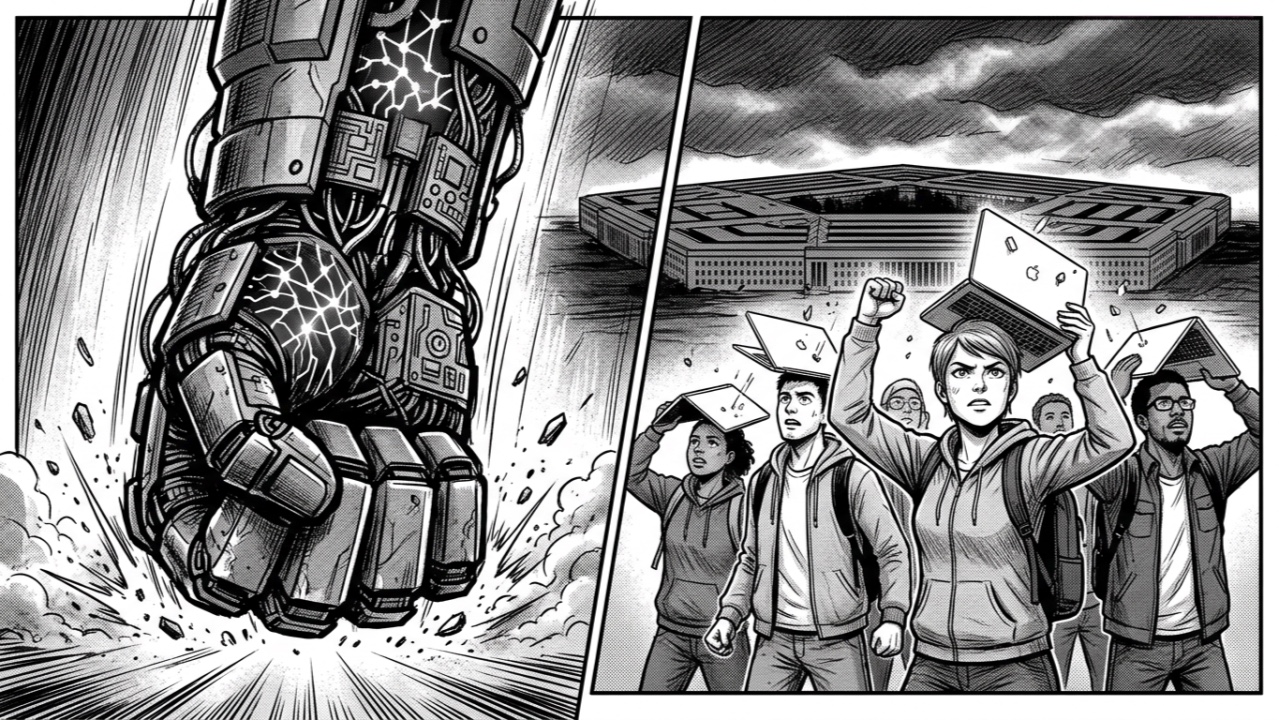
This week Anthropic became the first American company in history to be designated a “supply chain risk to national security” by the Pentagon.
I’m floored.
The same designation used for Huawei.
For Russian companies.
For suppliers from adversary countries.
And they slapped it on a San Francisco company founded by ex-OpenAI employees that simply said: “we won’t allow our AI to be used for mass surveillance of Americans or for autonomous weapons without human oversight.”
Then good old Dario (I really do like the guy, he seems like a decent person) publicly apologizes for a leaked memo in which he called OpenAI’s announcements “lies” and its employees “gullible.”
OpenAI launches GPT-5.4 with a million tokens of context and native computer use. I’ve tried it and it works well… it’s very, very autonomous, at least with code.
Wall Street is starting to call things by their name: “circular financing,” the same money going round and round between Nvidia, OpenAI, Amazon and Microsoft. And DeepSeek is about to drop its V4 model at a moment when Silicon Valley no longer knows whether it’s competing against China or against itself.
And the cherry on top: the Commerce Department has drafted a global licensing regime so Nvidia can’t sell a chip without Washington’s permission, Oracle is weighing laying off 30,000 people to pay for the GPUs it promised in Stargate, and the federal cybersecurity agency (CISA) is quietly crumbling.
What sends chills down my spine isn’t any of these stories on its own.
It’s the pattern I’m seeing.
Companies that set ethical limits get punished. Those that fire people get rewarded. Those that raise $110 billion do it with money that flows back to the same companies that gave it to them.
It’s a textbook “follow the money.” Follow the money and everything fits: the same capital circulates among the same five companies, and the market rewards whoever plays the game and punishes whoever asks the uncomfortable questions.
Thanks for reading. If this brings you value, share it. If you want more detail, keep reading.
THE BOMBSHELL OF THE WEEK
Anthropic declared a “national security risk.” Amodei will sue the Pentagon.
Last week I told you how Trump had blacklisted Anthropic. This week, the situation has escalated to a point nobody imagined.
On Wednesday the 4th, defense-tech companies were already telling their employees to stop using Claude and switch to other models. That same day, TechCrunch published excerpts from an internal memo in which Amodei called OpenAI’s announcements about its Pentagon deal “straight up lies.”
On Thursday the 5th, Anthropic received the official letter from the Department of Defense confirming its designation as a supply chain risk. Effective immediately. Every contractor, supplier and partner doing business with the American military must certify that it does not use Anthropic models in its Pentagon work. It’s the first time an American company has received this designation. Amodei posted that “we have no choice but to challenge this in court” . That same Thursday, Microsoft came out publicly to say Anthropic remains available on its platforms for everything outside Defense. And the Financial Times reported that Anthropic has reopened talks with the Pentagon. The same day it says it will sue, it returns to the negotiating table. That’s how Washington works.
On Friday the 6th, Fortune published the full leaked memo : Amodei described the OpenAI employees who backed the deal as “gullible” and its online defenders as “Twitter morons.” Amodei had to apologize publicly : “It was a difficult day for the company. I apologize for the tone. It doesn’t reflect my careful or considered views.” And Google joined Microsoft in saying Anthropic remains available outside Defense. The two giants protect their AI partner while the government tries to suffocate it.
The signal: we are watching, in real time, the precedent being set that AI is a national strategic asset, not a technology product. The company that sets ethical conditions pays the price. Those that sign get the contract and the benefit of the doubt.
900 GOOGLE AND OPENAI EMPLOYEES REBEL AGAINST THEIR OWN COMPANIES
“We Will Not Be Divided”: the letter defying the entire industry
The open letter “We Will Not Be Divided” that started with a few hundred signatures last week has grown to nearly 900 signatories by Tuesday the 3rd . Close to 800 Google employees and nearly 100 from OpenAI. Hosted at notdivided.org , it asks for two simple things: that AI not be used for mass surveillance of American citizens or for autonomous weapons that kill without human oversight.
“They are trying to divide each company with the fear that the other will cave,” the letter says. “We hope our leaders will set aside their differences and stand firm.”
The perfect contrast: OpenAI employees sign a letter supporting Anthropic’s red lines while their own company signs the deal Anthropic rejected. According to CNN , some OpenAI employees are “furious” about the Pentagon deal. Sam Altman said he wants to “help de-escalate” the tensions, but hasn’t explained what exactly that means when you’ve already signed the contract.
Why it matters NOW: 900 people inside the most powerful AI companies in the world are publicly saying they don’t want their work used to kill people without human oversight. And their bosses are signing deals that make exactly that possible. This is the AI era’s “Google Walkout” moment.
THE BLOCK HANGOVER: “AI-WASHING” OR REAL REVOLUTION
Bloomberg and Fortune dissect Dorsey’s 4,000 layoffs. And the verdict isn’t unanimous.
Last week Jack Dorsey laid off 40% of Block (4,000 people) blaming AI, and the stock rose 17%. This week came the scrutiny.
Bloomberg opened fire on March 1 : “Dorsey’s cuts arouse suspicions of AI-washing.” Analysts point out that Block had an efficiency problem that had nothing to do with AI, and that Dorsey wrapped a classic restructuring in the moment’s most fashionable gift wrap.
Fortune went deeper on Wednesday the 4th with “3 questions every CEO needs to ask about the AI doom loop” after Block’s layoffs. The Q4 results said Block wasn’t in trouble: gross profit of $2.87 billion, up 24% from the previous year. So why fire 40%?
The signal: 2026 is the year “laying off because of AI” becomes the new “pivoting to blockchain.” The difference is that this time there are real people losing their jobs, and Wall Street pays a premium for it. And other CEOs are taking notes: Oracle may be next with 30,000.
MONEY TALKS
AI’s circular financing: Wall Street starts calling things by their name
On Thursday the 5th, Wall Street named the elephant in the room : “The Great AI Loop.” Bloomberg published the investigation the entire industry was waiting for but nobody wanted to write: “AI Circular Deals: How Microsoft, OpenAI and Nvidia Keep Paying Each Other.”
The mechanism is simple. Nvidia invests $30 billion in OpenAI. OpenAI uses that money to buy Nvidia chips. Amazon invests $50 billion in OpenAI. OpenAI expands its AWS contract by an additional $100 billion. Microsoft invests in OpenAI. OpenAI runs its models on Azure. The same money goes round and round, and every time it changes hands, someone books “revenue” and “growth.”
They’re calling it “revenue round-tripping,” and the comparisons to the dot-com bubble are becoming less and less metaphorical. OpenAI will lose $14 billion in 2026, despite billing $25 billion. But its suppliers book those losses as their own revenue. If the capital stops flowing, the chipmakers’ and cloud providers’ revenue evaporates just as fast.
I don’t believe in conspiracies. But I do believe in incentives. And the incentives here are perfectly aligned so that nobody wants to be the first to say the emperor has no clothes.
Context: the rounds feeding the loop
For anyone joining this week, the context of recent weeks is necessary to grasp the scale. OpenAI closed $110 billion on February 27 (Amazon $50B, Nvidia $30B, SoftBank $30B) at an $840 billion valuation. Anthropic closed a $30 billion Series G on February 12 at a $380 billion valuation — the same company the government just declared a “national security risk.” Private investors and the Pentagon live in parallel realities.
And SpaceX, which absorbed xAI in February creating the largest merger in history ($1.25 trillion), is preparing a confidential SEC filing this month targeting a $1.75 trillion valuation. Orbital data centers. IPO in June, coinciding with Musk’s birthday and a planetary alignment. I am not making this up.
THE UNITED STATES WANTS TO CONTROL EVERY AI CHIP ON THE PLANET
The Commerce Department drafts a global licensing regime for Nvidia and AMD
This is the story that should matter most to any CTO and is getting the least coverage.
Also on Thursday the 5th, Bloomberg revealed that the US Department of Commerce has drafted regulations that will require government permits for Nvidia and AMD to sell high-performance AI accelerators to any country in the world. Not just China. Anyone.
The tier system: up to 1,000 Nvidia GB300 GPUs, a review process with possible exemptions. Larger deployments: mandatory prior approval, including business model disclosure and government visits. More than 200,000 GB300s owned by a single entity in one country: the host government must participate in the American approval .
Translation: if you’re a European, Asian or Latin American company planning large-scale AI infrastructure, you now need permission from the American government. Washington is turning AI chips into the new oil, and it wants to be OPEC.
The signal: any CTO planning international AI infrastructure now has a new geopolitical risk that didn’t exist last quarter. And the supreme irony: these restrictions are exactly what has accelerated China’s development of its own supply chain, as Bloomberg itself argues .
PRODUCT SECRETS
OpenAI launches GPT-5.4: a million tokens and native computer use
On Thursday the 5th, OpenAI launched GPT-5.4 , its most capable frontier model to date. A one-million-token context window (the largest OpenAI has ever offered), native computer use capabilities (screenshots, mouse, keyboard), a 33% reduction in hallucinations versus GPT-5.2, and 83% on the GDPval benchmark evaluating knowledge work across 44 occupations. Simultaneous rollout across ChatGPT, the API and Codex.
The telling headline came from Gizmodo: “OpenAI, in Desperate Need of a Win, Launches GPT-5.4.” When your own launch is perceived as defensive, you have a narrative problem. And with DeepSeek V4 about to drop, the pressure to prove American models are still ahead is more real than ever.
DeepSeek V4: the model that could knock Wall Street down again
DeepSeek is about to launch its V4 model , the first major update since R1 in January 2025. It’s multimodal (text, image, video), has a one-million-token context window, and is a one-trillion-parameter model with 32 billion active via MoE. They’ve optimized it for Huawei and Cambricon chips instead of Nvidia . They haven’t shown it to a single American chipmaker.
The timing isn’t accidental: it coincides with the “Two Sessions” of China’s parliament. Remember that when DeepSeek launched R1, it wiped $600 billion off Nvidia’s market cap in a single day . If V4 proves you can train competitive models without American chips, the “Nvidia is indispensable” narrative starts to crack.
Apple launches the MacBook Neo at $599 and buys Google’s AI
On March 4, Apple executed a multi-city launch (London, New York, Shanghai) without a traditional keynote. The star product: the MacBook Neo at $599 , the first Mac powered by an iPhone chip (A18 Pro). 13 inches, Liquid Retina display, 8GB of unified memory. It also introduced the iPhone 17e at $599 with 256GB base storage and a touchscreen MacBook Pro for the fall.
The real strategic move isn’t the hardware. It’s the context: these products hit the market while Apple grows ever more dependent on Google. In January, Apple announced that Google’s Gemini will power the new Siri in a deal worth approximately $1 billion a year, with iOS 26.4 arriving in the coming weeks. Apple, the company that built everything in-house, has had to buy AI from its biggest rival. It’s no coincidence that Alphabet overtook it in market cap for the first time since 2019.
REAL NUMBERS
OpenAI bills $25 billion. Anthropic $19 billion. Neither makes money.
OpenAI’s annualized revenue reached $25 billion at the end of February, growing 17% in just two months. Anthropic is approaching $19 billion, with 80% coming from enterprise customers and more than 500 companies spending over a million a year. Eight of the Fortune 10 are active Anthropic customers.
And yet, OpenAI will lose $14 billion this year. The world’s highest-billing AI company is hemorrhaging money. The growth is real. The sustainability is not.
Oracle may lay off 30,000 people to buy GPUs
Bloomberg reported on Thursday, March 5 that Oracle is evaluating cutting between 20,000 and 30,000 employees to generate between $8 billion and $10 billion in cash flow to build AI data centers. The trigger: Oracle’s commitment to supply 3 million GPUs over five years through Stargate, valued at $156 billion, has created a liquidity crisis.
Read that again. A company selling off its human capital to buy compute. If confirmed at the high end, these would be among the largest layoffs in American tech history. And the cause isn’t “AI replaces jobs.” The cause is “we committed to a contract we can’t pay for.”
The 2026 layoff wave: 53,000 and counting
The year’s running total is devastating: 52,955 tech jobs eliminated in 2026 , 815 people a day. In the first week of March alone: 5,305 more layoffs . And if Oracle confirms the 30,000, that figure doubles in one stroke.
The big names’ running total so far this year: Amazon 16,000 (January), Block 4,000 (February), Morgan Stanley 2,500 (March), Meta 1,500 in Reality Labs (January), eBay 800 (February). The declared driver in almost every case: AI. The real driver in many: classic restructurings wrapped in an AI narrative because Wall Street pays a premium for it.
AI infrastructure: $700 billion in data centers in 2026 alone
Hyperscalers will spend nearly $700 billion on data center projects in 2026 . The breakdown: Amazon $200 billion, Alphabet $175-185 billion, Microsoft $120 billion+, Meta $115-135 billion, Oracle $50 billion. Jensen Huang estimates between $3 and $4 trillion in AI infrastructure by the end of the decade .
The question nobody wants to ask: if the circular financing stops, who pays those $700 billion?
THE DRAMA
Amodei vs. Altman: the memo that shattered the fiction of collegiality
Amodei’s leaked memo isn’t just embarrassing. It’s revealing. Calling OpenAI’s announcements “straight up lies” , describing its employees as “gullible” and social media commentators as “Twitter morons” reveals what these CEOs really think of each other. The AI competition isn’t just commercial. It’s deeply personal.
Altman responded with calculated elegance, saying he shares Anthropic’s red lines . It’s the perfect move: you look reasonable while your rival self-destructs in public. But 100 employees of your own company signed the letter against what you just did. OpenAI’s internal fabric is more strained than the public facade suggests.
30 former military and intelligence officers have written to Congress asking it to investigate the “dangerous precedent” of the Pentagon’s attack on Anthropic. When retired military officers themselves say the Pentagon has gone too far, this is serious.
CISA crumbles: the federal cybersecurity backstop is quietly being dismantled
Almost nobody is covering it. On Friday the 6th, Shelly Hartsook, CISA’s associate director for cybersecurity, resigned . With her go more than $84 million in eliminated programs, including the entire election security program and the cyber defense education program. CISA has lost roughly a third of its 3,400 employees since early 2025.
Why it matters NOW for any CTO: the federal safety net in threat intelligence that American companies (and by extension, their global partners) took for granted is being dismantled piece by piece. If your security plan depended on federal collaboration, it’s time to budget as if it didn’t exist.
THE WEEK AHEAD
March 11: two regulatory deadlines that will change the rules. The Commerce Department must publish an assessment of “excessively restrictive” state AI laws that could be overridden by federal policy. And the FTC must issue its official position on how antitrust law applies to AI. Colorado already has its AI Act taking effect in June. The regulatory battle is heating up.
March 11: The MacBook Neo and iPhone 17e go on sale. The first sell-through data will tell us whether Apple can compete in the $599 segment and whether the A18 Pro chip in a laptop has real traction.
DeepSeek V4 could drop at any moment. If the benchmarks are competitive with GPT-5.4 and it’s optimized for non-American chips, the market impact will be immediate. Watch Nvidia on launch day.
Oracle: confirmation of the mass layoffs. If Bloomberg is right about the 30,000 figure, it will be the catalyst for a national debate about “AI as excuse” vs. “genuine transformation.”
SpaceX IPO may file confidential paperwork with the SEC this very month, targeting a valuation of $1.75 trillion . If confirmed, it will be the largest stock market debut in history.
Anthropic vs. the Pentagon continues on two simultaneous tracks: negotiation and preparation of the lawsuit. The outcome will define whether AI companies can set conditions for the government or whether AI is a national strategic resource over which Washington has the final word.
Thanks for reading.
Onwards